

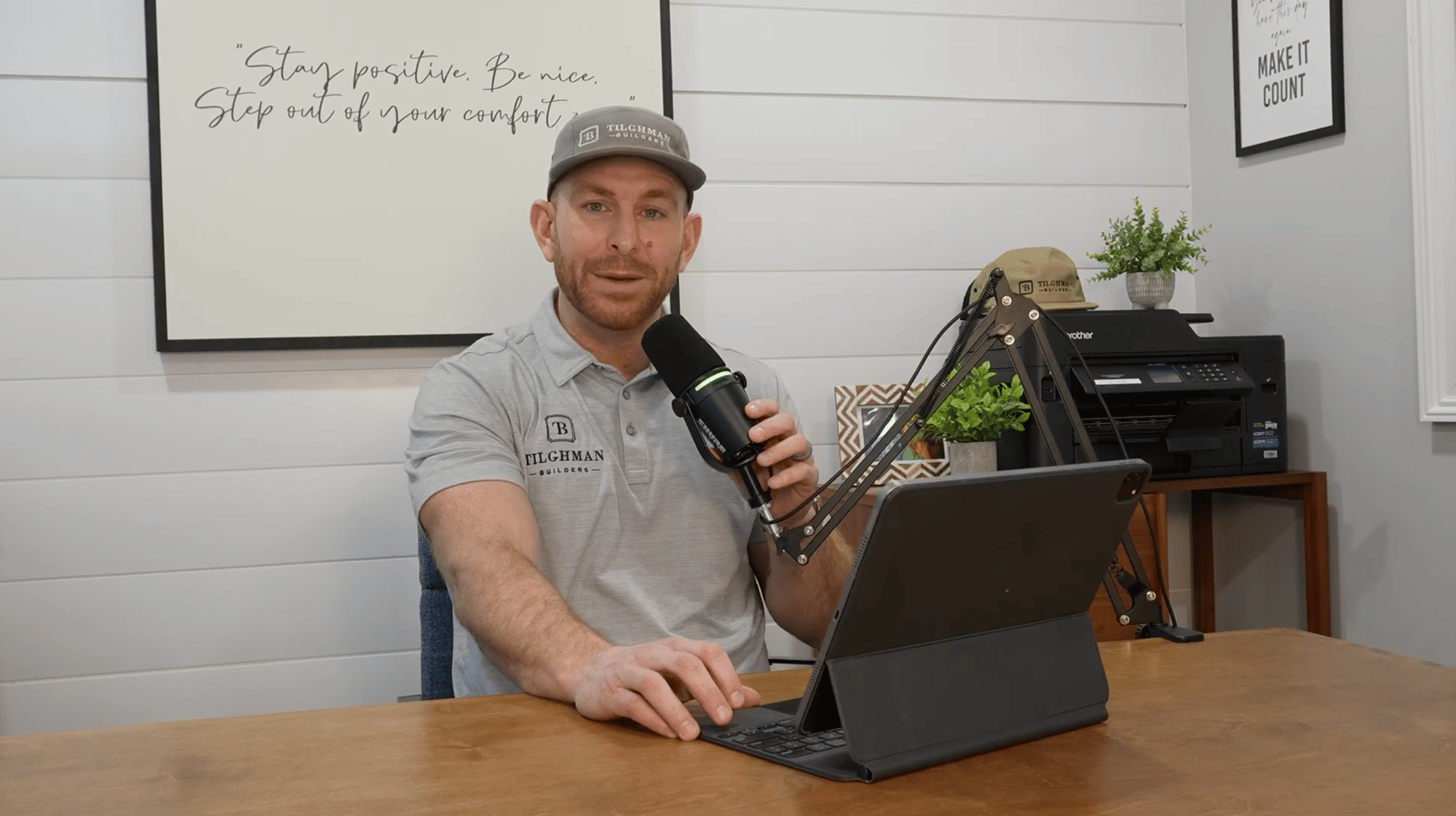
If your team isn’t performing and the day-to-day vibe is frustration, stress, or constant disappointment—this episode is where you start.
In The Man in the Mirror, Eric Tilghman breaks down why company culture isn’t “soft”—it’s a profit lever.
Turnover, callbacks, reputation damage, and burnout are often culture problems in disguise.
And the hard truth? Culture starts with the owner: your emotional discipline, your standards, and what you tolerate.
Because culture exists whether you build it or not—if you don’t design it, it forms accidentally.
WATCH HERE:
Follow and listen to other episodes here:
 |
 |
 |
Hi everyone, welcome back to another episode of the Built Different podcast. I'm Eric Tilghman, your host and the CEO of Tilghman Builders. Today we're gonna be talking all about if you don't have a company culture, where should you start?
So if you're a business owner out there trying to do the best with your business and you feel frustrated or I don't know, there's a lot to it. But if you just feel like your team isn't performing the way that they should. if your day-to-day vibe is that of frustration or anger or disappointment or anything like that, we've got some work to do and I think I could maybe help. And so we're kind of just talking about this week, where to start, where to begin. I'm gonna tell you a little bit about my journey during this week's episode, but hopefully give you guys a lot of good insights and kind of places that you can start and things that you can do just to get things moving in the right direction. So I'm naming this podcast The Man in the Mirror, and we'll get to why, but just wanted to start there. There's some hidden costs.
Most owners don't see them. Most owners only calculate labor, materials, and overhead. But some things that they don't often calculate are turnover costs, training replacements, callbacks from careless work, customer reputation damage, emotional drain on leadership. you know, culture really isn't a soft thing. Really, it's a profit lever.
I never really looked at it that way, but it's certainly true. I look at culture, kind of my opinion of culture and the reason why I'm drawn to it is I just like it. I just want to feel good at the end of the day. I want to feel like I'm building a company that I'm proud of, one that I can be myself at, one that makes me happy, one that makes other people happy. But as a byproduct, culture certainly drives profit. So it could be looked at as a profit lever.
So another point that I've made over the years is that culture's there whether you know it or not. If you don't design it, it forms accidentally. So I'm speaking mainly to people in the home services industries, but really everyone. I hope this podcast gets out to everybody and that you guys will change your life and the way that you run your business and the way that you make decisions. But in the, I'm a home remodeler, and so I wanna talk about townships. You walk into any township building for some permits, and there's a culture. It might be cold, certainly not fun, doesn't look like anybody really loves their job or loves their work, and it's a culture, you know? It's a seemingly nasty culture I'm glad I don't work at a place like that but it's there, you know, and so your company I'd like you to you know, take a look at it and whatever the vibe is I mean, that's the culture whatever you however you make decisions, know, whatever standards you have your culture set it just may not be intentional and so if you are not intentional about building your culture silence becomes the culture. Negativity becomes the culture. Or just get it done. Just get it done, hurry up. We gotta get this done, right?
So what behaviors are rewarded in your company right now? What behaviors are tolerated? What behaviors are ignored? These are all things that are making up your culture. This is a big one, guys. So it starts with the owner's emotional discipline. A lot of companies struggle because the owner is reactive. The owner explodes under stress. The owner complains about clients in front of the crew. The owner tolerates negativity because that's just how construction is. Your team will never be more disciplined than you are. Or as John Maxwell would say, he would call that your leadership lid. So your company cannot outgrow you as the leader. It's a lot of pressure.
It's a lot of pressure on the owner to show up as their best selves, you know, and to constantly improve and push themselves. I would imagine it would be really hard for me to push my team if I wasn't also pushing myself. And so anyway, really give that some thought. Your company cannot outgrow you. It's impossible. It won't happen unless you step down and perhaps name someone your CEO or, excuse me, or sell the company to somebody else. essentially that is true. So I wanna share a little backstory on me. You may feel like this is painful to share. It's not, believe me. I've said this story many, many times. I share it openly because it's my story, it's part of it. And I'm proud of it, because this is where I was and where I am today is different. So I was, this is a family business, been in business 45 years. I've been in this company since I was 13. And then I became a lead carpenter eventually after college and things like that. I'd gotten fired for a short period of time, for three years, not that short actually. But basically the story goes like this.
I was a lead carpenter for about 12 years. I was grumpy, I was aggressive, angry, frustrated, and rightfully so. Why rightfully so? I'll tell you. Because nobody could make a cut as good as me. Every time anyone did anything, they did it wrong. I felt like I had to do everything myself until one day my team surrounded me and they had an intervention. Basically they told me, look, you're a terrible leader, man. We don't enjoy working with you and we all kind of agree. So you can imagine that was a tough day. It was hard to hear. I denied it at first, obviously, until I had a little space, a little time to really reflect. And what I really realized was I had been a terrible leader in my personal life as well. I was thinking about only the negative things in my life. I was drinking way too much. I was not allowing any love into my heart. And therefore I couldn't give any out. But I was the problem. I was the problem, 100%. But in my mind, they were the problem. In my mind, I remember that time. This was many years ago. This was probably eight years ago or nine years ago at this point, but I remember, man, I was a grump. I was a total grump. And I was negative and I was mad at my team and life was hard. So I set out on a journey to learn how to be a better leader. And that's when I really realized this is I was learning leadership for the first time. And I realized how much I had been missing the mark. And so really, for things to change, you have to change. That's a Jim Rohn quote that I love. I live by that, I teach that to my team, and there's just no way around it. For things to change, you have to change. It'd be like, I don't know, it'd be like me hoping my physical appearance would change. I'm gonna look in the mirror and hope that my physical appearance changes without changing my physical appearance. It's impossible, right? In order for the reflection in the mirror to change, I have to do something to change my appearance, cut my hair, work out, whatever it may be. But so for things to change, you have to change.
Anybody going down this journey, John Maxwell, Jim Rohn, Simon Sinek, these guys are who you wanna be listening to. Probably not me, to be honest, but whatever, just trying my best here. So I began learning about leadership. I really wanted to, you know, I'm a people pleaser. I want people to like me, you know, and I just heard, right, that nobody did.
You know, they didn't like working with me. They didn't enjoy their day spent with me. And that was hurtful for me and I needed to change it. So I began each day waking up 4 a.m. with gratitude, intention, and I really just started driving my life in the direction that I wanted. I stopped trying to catch people doing something wrong. And instead I started trying to catch them doing something right. My delivery and instructions, they got more detailed. They got softer. I got softer in my delivery.
more concise and so it was easier to understand my directions. And you know, I needed them to understand my direction. I needed them to because I now wanted to catch them doing something right. So the quicker I could get them to do something right, the faster I'd be able to show them that I was good for it, I was good for a compliment or whatever it was. Without that, we couldn't start. And so then I started complimenting them often. I started showing gratitude and saying little things to let them know that I care. This took time. I also, prior to this, was giving them shaky boots, right? They were scared. They were walking on eggshells around me. It was awful, I'm sure.
So I needed to give them confidence. When they made a mistake, I needed to remain calm and I needed to take on kind of a no big deal, better luck next time kind of attitude, you know?
I needed to be calm is what I needed to be. And for all you construction guys out there, you know, it's common, you know, it's the industry, you know, it says that it's okay to be an aggressor or like to be. And so I just, you know, I started basically just treating them different. I started remaining calm when there were problems and things like that. But really it all started with the way that I woke up. I really needed to wake up and be grateful and love my life. There were problems in me that existed that I needed to resolve. I needed to love my life and I needed to look forward to the excitement that I might find throughout the day. And I needed to be grateful for my team and my family at that point in my life. so, anyway, needless to say, over time, I got results. I got results from this new approach, this new approach of leadership. This is important to anyone really embarking on this journey. Results will come, but they're not gonna be overnight. If you're gonna sign up for this, you know, buckle up and, and, you know, stay hydrated because it is a long, it is a long journey. It really is. Eventually, I got hooked on leadership and business and personal development. And eventually I stumbled upon the importance of company culture. And so here's where I started. Okay. I started sending out weekly huddles. So this was an email I would send out. I would lay out the upcoming week. I would highlight the week that had just passed.
And I would highlight displays of excellence. Excuse me. I would also share personal personal growth content. So, you know, these are construction workers, right? Similar to me. I had never heard anything about this. didn't I didn't really apply myself until later in life, until really right around this time. And it was then that I learned that YouTube was out there and that there was endless content around personal growth and development, changing your mindset, all this stuff. So I started sharing it with my team on my huddles, on my weekly email huddle that I would send out. So I'd send them YouTube videos and inspirational quotes, business quotes, things like that. I did this for about two years.
Basically just kind of shouting into the abyss. Nobody cared, nobody responded to my emails. I didn't even know if anybody was reading them. I would have the schedule on there, so I knew that they would click on the schedule for the next week. I didn't really think anybody was really paying attention until one day. One day I went into my email, I went into my email and I saw a subject said, midweek shout out. And basically what it was, it was two guys. They're both same age. They both got paid the same. They had the same title in the company. And the one was giving a shout out for the other. oh, I should back up. In the huddle, I would provide shout outs. So, shout outs were me highlighting people that did excellent things the week before. Shout out to Greg.
I heard from the customer that the whole crew stopped, got off the roof and helped her carry in her groceries. That's incredible. Way to go, Greg. Right? Stuff like that. Until this midweek shout out. First time ever, one guy shouting out another guy, equal pay, same age. In any other company, they should be competitors. They should be withholding information and undercutting each other and backstabbing and all the things that we would normally see in a business, or at least in a business with a bad culture, this was my first sign. And this was two years, two years before I saw anything like this. And that's when I kind of realized I was on the right track. And that helped me continue. if you're just starting out, if your business is, like I laid out earlier, if it's bringing you frustration, anger, resentment, all these negative feelings, like, you're not, it's not, that's not right. It shouldn't be that way. Your business should be a reflection of who you are. It's part of your life. And just like we get to build our life, we get to choose our partner, we get to choose the values we instill in our children. We get to choose how we grow our company. We get to choose what values and vision, would be important for the company. So really your next thing here is discover your values and your vision. Ask yourself, what do I want in life? What do I feel called to do? What is the problem in my industry that I think we can fix? For me, I wanted to build a place where people could work, grow, feel safe to be themselves. I wanted them to show up exactly how they are. I wanted them to be able to speak freely and go home at the end of the day feeling productive, fulfilled and excited about the next day. That's what I wanted. I really wanted this to be an awesome place to work. And now it is. But it wasn't for a while. It wasn't. I also wanted to build a company that would eliminate all of the issues in our industry. Ghosting clients, rude behavior, being aggressive towards your employees, laying off in the winter, not showing up on time, not following through.
The list goes on. I mean our industry is it's brutal. It's really brutal And so that's those are kind of the two things that I wanted to fix And so I you know, I decided to go big and that that's not for everyone I'll share my vision in just a moment. You'll see how big I I want to take this And you know, that's not for everyone, you know, we've grown our company since then since I had my leadership intervention, we've grown our company. We had about seven to 10 employees at the time, and now we're pushing about 40. That was, well, the intervention was, like I said, think eight, maybe nine years ago. But when I got into the office, before I could start making any real changes, the three years I was in the field, I was just working on me. That's really all I was doing. I was learning a lot about business but I was working on me. ran a couple marathons during that time, different things like that. Again, just trying to apply myself for the first time ever. But since I had gotten in the office about six years ago, that's where the growth sort of started. So going from about seven to 10 employees up to around 40, and everybody loves their job. Everybody that works here loves working here, and our clients feel it. It's beautiful.
What we've got here. we're far from the vision being complete. Maybe we'll never get there. But you know what? Number one, I kind of just said that, but I don't actually think that that's true. I actually truly believe that we will get there. And regardless of whether or not we do, I have a whole lot of fun doing this. I love this. I love this life that I get to live this business and affecting people in a positive way, which takes me really to my next point. I have a major purpose. I love my purpose. And not only that, but I've given 40 other people purpose in their own lives and one that is bigger than themselves. And that's all important stuff. So my next point really is make sure that your vision is big enough for everyone else to fit within it.
My vision can't be just about me, and it never was. I just kind of read you my vision, you know, to provide my team members with a wonderful place to work and grow and feel fulfilled and all that stuff. That really was the vision. That was important to me. But, you know, your team must be able to see their own vision play out within your vision. So a couple things I want to share with you.
So really, you got to establish your values and your vision. Our values are honesty, accountability, and kindness. Our mission statement to provide homeowners with a worry-free and pleasant experience while renovating their home, we do so by means of quality people, clear communication, and genuine consideration for their homes and their daily routines. So what I really want in how we run a project or how I want a customer to feel, I want them to feel like I want them to be able to drop their shoulders and relax. I want them to feel comfortable being themselves. I want our customers to let their guard down and trust us. And I want them, throughout the process, there's many different phases of this whole process. Project development, there's construction, there's post-construction. I want them to, at every point, I want them to say, man, I am so glad we chose Tilghman. These guys are incredible. That's what I want.
You know, and I think that that's what we have. So that's kind of the mission. That's kind of like the day to day mission. Our guys are reminded of that every morning with their morning huddles. But then we have our vision. So basically my vision is to change the industry in the, I'm sorry, to change the standard in the construction industry. I grew up in this industry. It's broken. It's got a whole bunch of things wrong with it. And I don't think I'm the only guy out there trying to make this change, but for me, it's on paper, it's what I want. I really wanna make a positive stamp on this industry. And that's what we're doing. So to change the construction industry standard nationwide, so that's going big, by proving that honesty, accountability, kindness, and excellence can coexist and win. So I wanna redefine what it means to be a contractor by how we treat people, our employees, clients, and vendors.
And then this is something I've said to our team many, many times. We are a family business and more than that, we are a movement for good. So now that is a big vision, right? There's a lot of growth there, which is why my team, they can see their own vision for their life play out within that vision. The ceiling for each team member is very high. It's not even high, it's indescript.
It's whatever you can imagine, you know, I encourage my team members all the time. Tell me your goals. Tell me what you want so that I can put that into my own vision and goals. You know, it's important that it's important that I know what my team members all want in life. You know, hey, one day I'd love to be in sales. Really? I didn't. I never thought you'd want to do that. Well, you'd be probably pretty good at it. Huh, let me think about that for next year. That's how this works. It's how all of this works.
Our standard, this is something we just recently added, so I can't take credit that it's been around too long, but it's true. Our standard when things go wrong, I added this to kind of our mission statement. When we make a mistake, we communicate immediately, take responsibility, and we make it right. Couldn't be more true. The other thing I did, and maybe, you should do is we started having team meetings once a month, once a month for two hours, everybody comes in. And those team meetings, I cover some things, things that we could improve on from the previous month. I keep a note in my phone for things like that. But in the early days, a big part of this meeting was basically talking to them about the vision. I was sharing that like a lot. And I probably looked like a kook. Because we weren't there. We weren't there. And so I'm sure there was a lot of eyes rolling in the crowd. But I shared it time and time again, over and over and over.
You know, and I would say things like, we're different, we're going places. You know, I'm taking you guys with me. Like, what do you want? Like, we're gonna make it happen. We're not like other teams. We're, you know, we're different. We're unique. We're special. We got something that they don't have. Things like that. And again, it really wasn't, really wasn't super true. But I believed that that's where we were heading. And I truly, truly believed it. And I still do. There's a famous, kind of rule of thumb, I guess mainly in sales, but also in leadership, people don't need to believe what I'm saying. They don't need to believe what I'm saying. They need to believe that I believe what I'm saying, right? So that's where kind of passion comes in. so, you know, make sure whatever you find, make sure you find something that you're passionate about, like whatever direction you go.
Make sure that you love it and make sure that you really, really feel it. Otherwise, this would all feel fake and it would feel like work. And it doesn't. Here I am sitting here after hours making this podcast. I love this, you know? So make sure it's something that you really enjoy. But basically, I was excited about where we were going. They weren't excited and I needed to get them excited. Basically, that's it. I made some bold promises. I made some bold claims.
Imagine I'm sitting around with 10 guys telling them how big we're going to get and all this stuff and you know, and why and what's our purpose and what's our mission and vision and our values and all this stuff. And like, they were probably thinking I was nuts, you know, but but a lot of those 10 guys, they're still here today. And they're the biggest advocates of the company because they saw where we were. And they saw where we are now. So I'm grateful for those guys. You know, hanging in there, believing in me, and believing in our mission, you know. I wrote that at the bottom of every Christmas card for years. You know, thank you for putting your trust in our company. So this is Christmas cards to employees. Thank you for putting your trust in our company and sharing our vision for the future. I meant it, I meant it, I felt it, I said it over and over. So you can't hire your way out of a culture problem. So, that's true. So if you guys have employees, which I imagine you do, if you're watching this podcast, which hopefully someone is, but you can change your culture. You can keep the guys that you have, maybe. But many owners might say things like, we just need better guys. Nobody wants to work anymore. It's this generation, right? We've heard it. We've heard it.
Technically, I'm a millennial. I'm on the of the older side of being a millennial, but they used to say that about millennials. I used to say that about millennials before I knew that I was one. But, you know, it's not the generation. It's not. It's really high performers don't stay in chaotic environments. I'd like to tie this in with my last solo episode about onboarding and retention. I mentioned kind of that phrase, I can't find any good help. There's no good help out there. Really what that tells me is that your business doesn't have the systems needed to support good help. That's what that means. And that might feel painful to hear, but it's true. And the reason I know it's true is because it was true for me. I've been through this. And it stinks, but it's true. Good people leave bad leadership.
Faster than bad leadership fixes itself. So beware You know, you might have good intentions and you might start down this journey, but There's a good good chance that you'll leave I'm sorry that you'll lose some good people before you have an opportunity to get to your destination Just is what it is, you know, but good people leave bad leadership Faster than bad leadership fixes itself. So just consider that. Culture equals standards and accountability. Culture is not pizza parties, hoodies, and company outings. It's clear expectations, non-negotiables, and consistent enforcement.
In construction, especially culture shows up in clean job sites, organized trucks, how clients are spoken to, how problems are handled. I'd like to stop and just kind of tell you another quick story. My team has really never before. Well, other than the interventional lists, the people that told me I was a bad leader back in the day, which there's only one of those guys still in the business, maybe two. I don't remember the timeline, they've never heard me lose it. They've never heard me get upset or angry or frustrated. know, they've never heard me freak out. Okay. And that's because I try not to. Right. I mean, I've strengthened that muscle over the years and now I just kind of don't do that. But there was one time that I did that. They've heard me freak out one time. So, and I did it on purpose. It was when we had established a pretty good company culture and the guys were really getting along and things were moving in the right direction. I was really happy with where we were, but I had caught wind that there was some internal gossip. So basically, you know, it's common. It's common in business, it's common in construction.
But basically two guys were gossiping about each other or whatever. And when I caught wind of that, I intentionally freaked out. And what I wanted to show my team, it was at a team meeting and it was, I wanted to show them like, out of all the things that I could have freaked out about up until this point, a job not being ready on time, permits holding us up an inspection gone wrong and delaying some end date, whatever it may be, losing money, somebody quitting, whatever. They've never seen a reaction. But I needed them to see a reaction about this.
Internal gossip is cancer for a culture, for positive company culture. So I needed it to stop. I needed them to know like, okay, whoa, that's off limits. How come my oldest son still teases his brother, even though I've said, you know, please stop teasing your brother. Right? There's some things that they do that they know they shouldn't do, but they kind of still do it. Well, that's a culture, right? But how come my son never touches the hot stove? Because the first time he reached up for the hot stove, he saw me freak out. And he's like, okay, that's different than teasing my brother. Like that is actually really, really off limits. And so, you know, not the smartest guy in the world, but that was kind of like what I wanted to display to my team was like, things are going to happen. Things are not going to go my way. But internal gossip cannot happen. So just wanted to give you that little side note. If you want to scale culture is the multiplier you're aiming to. So a five man crew can survive on personality. A 40 person team.
Cannot. As a company grows, communication gaps widen, mistakes multiply, attitude spreads faster. Without culture, scale creates chaos. With culture, scale creates momentum. Remember, we're going places, we're different. You guys are going far. Hey man, I see something special in you, dude, keep going. You know, you're on the right track.
it creates momentum. So, well, it creates momentum because after saying things like that, then once they see the company scaling, everybody gets excited and everybody pulls together. That's the difference. Let's see. So, some easy tasks to really to start out. if you're, again, if you are at ground zero here, trying to figure out, okay, well, what's my next move? I want a good company culture. I want to have a really nice life that I feel good about. I wanna be able to rest my head on my pillow at the end of the night and feel fulfilled. And I wanna feel good about what it is that I'm building.
If that's you, I would recommend a few things. Define core values, three of them, not 10 of them. Things that make up who you are. Really, I think that's one of the reasons why we're successful in this company with our values. Because the values are really, they're reflection of my own personal values. know, honesty, accountability, and kindness. That's not hard for me. It's not hard for me to show up and be that way. And it's not hard for me to preach that because I believe in it.
The other thing is vision. You really wanna figure out a vision for your company and you wanna share that vision often. Without vision, the people will perish. So sharing it constantly. As the leader of the company, you gotta be sharing the vision. Do not keep it quiet, please. Your team wants to hear it. They wanna hear, you know? Where's my future in this company? Is there a future in this company?
You share a big enough vision and they'll be able to answer that question for themselves. The other thing, this is something I can get really excited about and I would recommend it to anybody in life really, but certainly somebody who wants to change the company culture. Write down your primary aim. So primary aim, basically it's a journal entry for one day in the future, whatever it is. So maybe it's one year from today, maybe it's three years from today, maybe it's 10 years, doesn't matter.
But basically you want to pretend like it's a journal entry. It's so nice now that blah. Or today I'm waking up on this day and go into great detail. What kind of car are you driving into work? What kind of attitude do you have as soon as you wake up? What's the money in your bank account? How big is your team? How's your company structured at that point in time?
Like write it out, go into great detail. It's really a fun process. And I'll tell you the truth, I've cried every single time I have written a primary aim. Because I'll go into things about my children and my wife and the things that we do together. And they work. They really work. It's amazing. You might tuck your primary aim, tuck it away for maybe a year or maybe more than maybe a few years. And then guess what? You pull it out, you reread it and you're like, whoa. A lot of these things came true. And I bet more things would come true if you would read it more often. So primary aim is a fun exercise and I enjoy doing them. Stop tolerating one toxic person, even if they produce. So we all have them on our team. I don't, not at this point, but I did. And I made the mistake of putting up with it. I didn't have time to hire new people and so I didn't. So we put up with the toxic person.
The prima donna, whatever it may be. the next thing really start weekly communication with your team. I did a well drafted, it used to take me two hours to write the huddle. I used to write it on Saturdays. But basically communicate with your team. And I liked the email because I could include certain messaging that was important to me. Things that my team wouldn't have expected to hear.
Keep a consistent tone, clear expectations, upbeat and positive. Like I said earlier, we're different, we're going places. Other companies aren't like us. We're special. Schedule and stick to team meetings. We did monthly two hours every month. Everybody would come in, they would skip lunch that day, started at two, ended at four.
We would have pizza and soda and coffee for the guys. And so we would all just eat lunch and talk for two hours, I would present. And so anyway, that's some things you could get started on tomorrow, if you wanted.
I realized company culture mattered in 2017. I didn't get a chance to change it until 2020. A mistake you made early on, these are some things about me. One mistake I made early on was thinking that this was gonna be easy or overnight. It wasn't and it never was going to be. I don't know what I was thinking. But I enjoyed the process and I enjoyed learning about it and I enjoyed improving.
So for me, I was able to kind of endure the timeline. You know, it's been a long, it's been a long journey for me. But, but I've enjoyed it and I enjoy where I am now. A time you tolerated the wrong person for too long. Well, that many times at one point, I just needed the numbers, you know, I needed people to follow me and you know, that was just, you know, part of that time. That's all that was, but caused a lot of pain. A moment you had to level up as a leader. Well, I have to level up every single week as a leader. I mean, really, when do we stop leveling up as a leader? Certainly there was that intervention. That was my first leveling up. But honestly, I think the owner of a company, again, it's...It's a lot of pressure, you know, because the company cannot outgrow you. So the process can be pretty lonely and it can be, you you gotta always be thinking like, what could I have done differently? What could I have done better? How was my interaction with this person last week? What things as I enter this week are important? Who needs my attention? Who needs my help? Who needs a little chat about the weekend?
I felt disconnected from that person last week. How can I regain some connection with that person? Remember, this is all just a bunch of relationships, good relationships that require maintenance. That's essentially what this all is, or a big part of it is anyhow. We want to ask ourselves, are we building a company where people are proud to work for it, or is it just a place that they collect a paycheck. That's a big, big thing. That's a, you know, our vision, like our guys are carpenters, you know, we have a bunch of carpenters in the field and, but they're excited. They love where they work. They love their coworkers. They're proud. They're, you know, when we, we, we wear our Tilghman builders uniform with pride. It means something. I've said that to them many times before. I've said things like, you know, eventually, somebody's gonna see your t-shirt standing in line to get your lunch at Wawa or whatever it is. And they're gonna know a few things are true about you. They're gonna know that you're accountable. They're gonna know that you're honest. They're gonna know that you're nice. They're gonna know that you're polite. They're gonna know that you're self-aware. And they're gonna know that you're a skilled craftsman. And that wasn't true when I said it to them the first time, but it certainly is true now.
And I think it's only true because I said it was gonna be true. We wanna build something we're proud of. And we want our people to be proud of where they work. What do they say about your business when you're not around? I'll never know, but I have faith that they say nice things.
So really, I'm not trying to run a successful remodeling company in Pennsylvania. Really, I'm trying to prove that construction can be professional. Culture will win every time, and standards can be high without it being toxic. So I'm gonna kind of blow through these. I feel like the episode's getting a little long here. But for a business owner, especially in construction, culture doesn't start in the break room. It starts in the mirror. I love that.I love that. I've never heard that before, but it's so true. It starts with you. And so I would encourage any business owner out there to take, take your temperature. If you're, if you're trying to go down this journey.
And maybe I keep picturing somebody at the bottom where, I was where the culture was bad, but maybe you're kind of in the middle, regardless, take your temperature, right? Your company cannot outgrow you. So ask yourself, personal life temperature right here. How is my marriage or closest relationship? Really? Do my kids feel tension when I walk in? Do I bring stress into the house every night? Because here's the truth, if your home life is chaos, it leaks into your company. Emotional state check. Am I grateful or am I constantly frustrated? Do I complain more than I appreciate? Do I react emotionally or respond intentionally?
Do people walk on eggshells around me? You can feel, I can feel the old me in my questions here. Your emotional discipline becomes the emotional ceiling of the company. If you are reactive, the company will be reactive.
Integrity and character temperature. Do I gossip about employees? Do I complain? Do I criticize clients behind their back? Do I tolerate behavior I secretly dislike? Do I say one thing publicly and another thing privately? Would my team describe me as consistent? Culture collapses when leadership integrity cracks. Personal habits. So this one might hit a little hard.
Am I drinking more than I should? Am I numbing stress instead of solving problems? Am I physically fit or neglecting my health? Do I wake up disciplined or scattered? I like that one a lot. That one is, that's a powerful thing. Maybe something for another episode, but I'm all about waking up with intention and having things planned out. Am I sharp mentally or am I foggy? If I'm foggy, maybe I need to evaluate how am I spending my nights and weekends, you know? Or maybe I need to evaluate what food I'm putting in my body or how much caffeine I'm drinking or whatever it is. You can't demand high performance from your team if you're living undisciplined. Again, mean, all things point to the owner or to the person who is the CEO, which could mean chief executive officer, but it could also mean the chief energy officer. We're reading this book right now called Energy Bus by John Gordon, reading that with our lead carpenters, but that's what they talk about. So I like to make a point that you don't have to be the owner of a company to change the culture of the company. And I've made this point before and I'll make it again. If you are, let's say you are number 40 in a company of 100. And you start changing the company culture, I bet you find yourself within a couple years between the number one and the number five spot. Because you will drive results, people will talk, and all things will point to you. And it's inevitable they're gonna want you at the top. this isn't just for business owners.
Work ethic and standards, do I show up on time? Is my truck and office organized? Do I cut corners? Do I follow through on commitments? Am I growing or coasting? If your standards are average, your company will reflect that. Leadership courage? Am I avoiding hard conversations? Am I keeping toxic employees because they produce? Do I protect culture or production? When was the last time I corrected someone immediately? Am I clear about expectations or vague? Weak leadership.
Weak leadership tolerance creates strong dysfunction. Accountability mirror. This is a good one. Kind of the blame game. Or the opposite would be extreme ownership. So I love extreme ownership. Jaco Willink wrote a book called Extreme Ownership and it's basically taking accountability for everything, taking ownership of everything.
If somebody on my team messes up or makes a mistake or we have a problem, in my mind, the exercise I run through is this is all my fault, what could I have done? And I like to teach all my leaders in the company to take that same approach. It drives results, it enables change. Being the victim or blaming anybody for anything.
It takes away my power. I can't fix it if it's not my fault. anyhow, when something goes wrong in your company, do you blame the market, the economy, the employees, the clients, this generation? Or do you ask, where did I allow this? Owners often want better teams, but better teams usually follow better leadership.
Gratitude versus scarcity. Do I celebrate wins? Do I acknowledge progress? Do I recognize team effort? Or do I only see what is broken? A miserable leader creates a survival culture. A grateful leader creates a growth culture. That's gold right there. Growth temperature. Am I reading? This is a huge one, guys. Am I reading? Am I learning? Am I seeking mentors? Am I investing in my own development? Or do I think I've arrived?
If you stop growing, your company stops growing, period. It's funny, I didn't realize before this, but the whole vibe here is, it all points to the owner's capacity or the CEO's capacity. Identity check. All right, we're almost through, guys. Who am I becoming through this business?
Is success making me better or bitter? If my company doubled tomorrow, would my character hold up? Would my team say I inspire them or intimidate them? Your company will never consistently outperform the character of its leader. My favorite is who am I becoming through this business? Is success making me better or bitter? I love that.
You might want to ask yourself, are you in it for the money? What drives you? You know, that's a big question to ask. And you're gonna want that, you're gonna want to know that early on. For me, that wasn't the case, which is why this has been so much fun. So anyway, evaluate those things.
Before you fix your team, audit yourself. Before you rewrite your core values, rewrite your own habits. If you elevate, everything around you elevates. If you decline, everything around you declines. So if you're looking to turn your business around, it's not gonna be easy and there's gonna be naysayers. You will face tough times, you will face lonely chapters. But if you're willing to embark on this journey, of building a company culture that lifts the people around you, your life will be exponentially better and so will theirs. This should really be a fun process. Your clients will feel it too. in closing, I know this was a long episode, I apologize, it was a lot to get through, but just remember for things to change, you have to change. And as always, thanks for staying tuned.
Stay positive and step out of your comfort zone.