


Nobody wants to work anymore. You hear it constantly in construction — from other companies, from clients, even from people who should know better. But what if that line is just a way to avoid the hard work of building a company people actually want to work for?
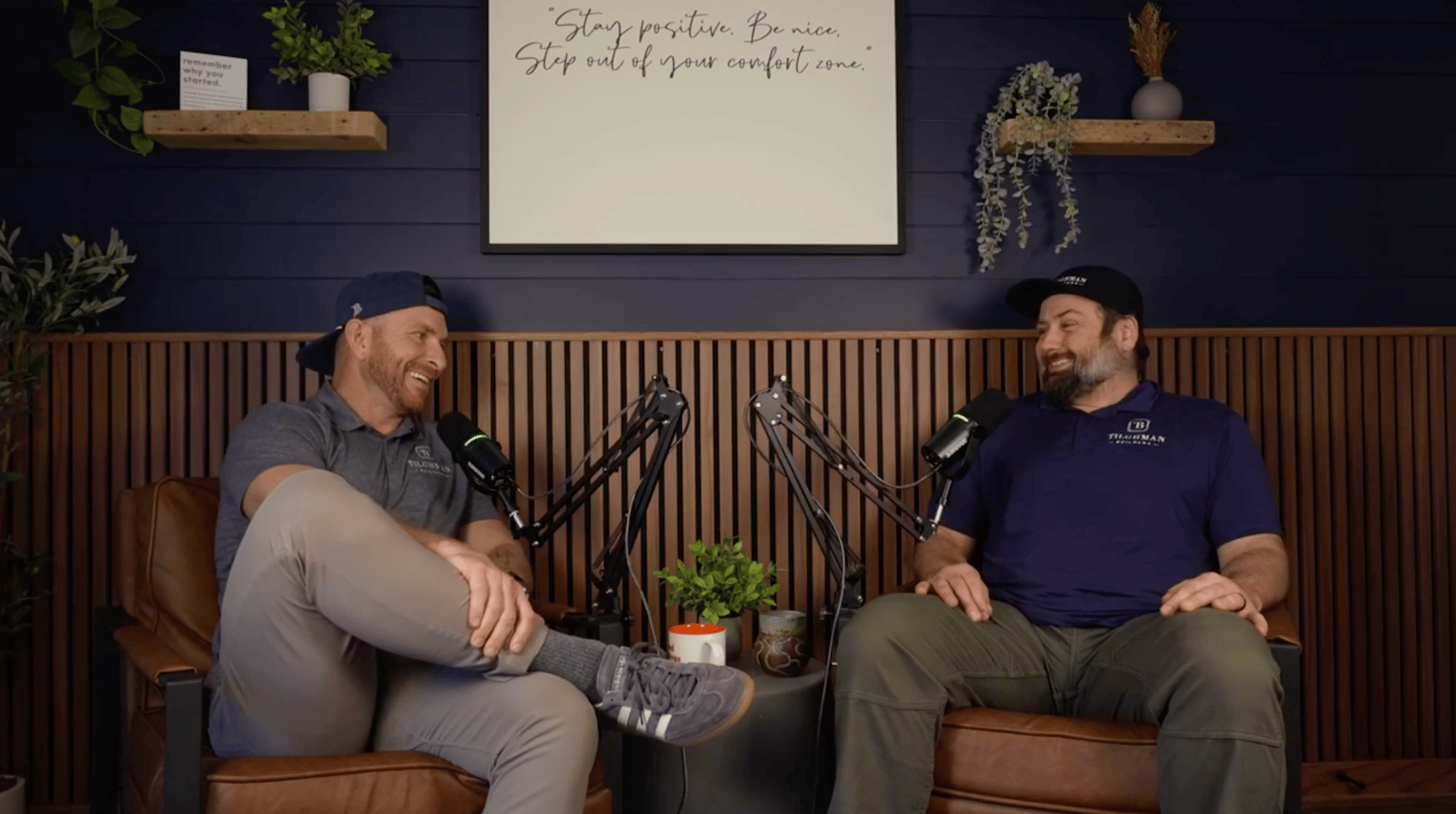
In this episode of the Built Different Podcast, Eric Tilghman sits down again with Tilghman Builders Operations Manager J.P. Melle to talk about the industry’s favorite excuse, and why they don’t buy it.
From why “you can’t find any good help” often means a leader has stopped looking, to what younger workers actually want — a future, a purpose, and a place they can grow — J.P. shares what he sees every day in the field.
Together, they explore how repeating a cynical belief talks you out of trying, why great people are out there if you’re willing to do the work of hiring and culture, and what it looks like when a team of 40 is the proof that the myth is wrong.
Because if you keep saying nobody wants to work anymore, you might just talk yourself out of finding the people who do.
WATCH HERE:
Follow and listen to other episodes here:
 |
 |
 |
Eric: Hi, everybody. Welcome back to another episode of the Built Different Podcast. I'm Eric Tilghman, the CEO and the host of the podcast. And with me again today is J.P. Melle. J.P., how you doing?
J.P.: I'm good. I'm great.
Eric: Good. Welcome to another episode.
J.P.: Thank you.
Eric: So this one's a little weird. You called me and said you had something you wanted to talk about, and I thought it was a perfect topic. Something you hear a lot. I hear it all the time.
J.P.: I hear it all the time.
Eric: Yeah. And I think it's stupid and self-defeating. I hear it even from known clients and smart companies. It's "nobody wants to work anymore." In this industry, everybody says it.
J.P.: Yeah, I get it a lot too. And we've been hearing it for years. I remember back in, like, 2022, we didn't have the team that we have today. I remember people saying that, and I was like, we just don't really have that problem. The other thing that I've heard, and we should tie this in, is "you can't find any good help anymore."
Eric: Yeah. Same thing.
J.P.: Right. And then there are a lot of comments about the younger generation too, which are maybe tied in with this. Like, "Oh, the younger generation doesn't want to work."
Eric: Right. Or "the younger generation, they want this or that." I'm like, actually, I'm really impressed by our younger guys. They're great. Some of them are phenomenal. And I think the funny thing about the younger generation is that people have been talking about the younger generation for generations.
J.P.: Good point. And the world is still running. They talked about our generation when we were, you know, not middle-aged.
Eric: Speak for yourself.
J.P.: Okay. I'm 39.
Eric: And I'm 42, and I probably look it more than you do, at least in the beard. But it can't have been true for generations, and it's not true for this generation. What it is, though, is a self-defeating statement. Hiring can be hard. Hiring is work that you have to do. Evaluating your guys is work that you have to do. And making your company a company that people want to work for is work that you have to do. So it's kind of avoiding that work, and telling yourself it wouldn't be worthwhile from the start, so you don't have to do the hard thing.
J.P.: Yeah, that's the way I look at it. And you're right, it is work. We got here, and now it's a little bit easier, because we have people we can rely on. We have systems we can rely on. We have admin, we have estimating, we have design. We have Sean. We have leads that we can trust. But for a guy with a small company, say it's just two or three guys, that poor guy does have it hard. It is hard for him to train and all that.
Eric: Sure. But as you were talking, I was thinking about the importance of a good, honest, vulnerable conversation. Like, "Hey Chuck, just so you know, I think you're incredible. I think you have major potential. We've got a lot of room to grow here, but how serious are you about working here? Let me tell you where I want to go as a business owner."
J.P.: A hundred percent.
Eric: Those conversations are important and valuable. So anyway, just a side note about the smaller guy.
J.P.: I was thinking about the smaller guy before we started, and our newest electrician immediately came to mind. Liberty Electric. Kyle is the owner. He started on his own, and he's got five guys now, all between 20 and 29. And I think the key is, guys don't want to work for nothing. They don't want to work hard to not have a future. They want to work hard somewhere they can see themselves advancing.
Eric: Yeah.
J.P.: And see themselves learning and growing and bettering themselves, bettering their lives, bettering their families' lives. Even for a small company, I'm sure he pays his guys well. He's given them a vision of a young company that's growing, something he wants to build. I know he's had conversations with Nolan, and I don't know if he's started with them quite yet, but I know he's moving towards it. And if his guys want to take classes and learn more and get certifications, the company pays for it.
Eric: Smart.
J.P.: And he's not having trouble hiring, and his crews are great. Our customers rave about them. The lead carpenters rave about them. So there are guys that want to work. When people walk into our office for an interview, they see a huge part of the vision already. But even for a smaller company, if you put the right things in place and treat your guys the right way, and like you said, give them the vision of what you're trying to build and let them know their place in it...
Eric: Right.
J.P.: There are lots of guys that want to work.
Eric: Really.
J.P.: I might say that's particularly true about the younger generation. They want to work for a purpose. And I could say that's true about me too, for sure. I feel so lucky with my life because I really enjoy the meaning that my work has to me. I like coming to work. I like thinking about work. I like working on work. And I wouldn't like it if it was just about the construction. It's about the team. It's about the happy clients, and how hard it is to make both of those true at the same time. It's about giving people an opportunity to grow. Man, the vision is so freaking important. It really is.
It's probably my favorite part of my job, bringing new guys in, seeing how they fit, how hard they want to work and how much they want to learn, and then seeing them take steps up the ladder here. And I think that's why I brought this up, because I hate the mentality. There are so many guys that want to work. Sometimes more than we can hire. Sometimes I'll do a round of interviews for two positions and I want to hire four guys. And it sucks.
And they want to work. We're light on work right now, and Christian is outside, and I just sat and watched him for like a minute and a half. He's out there finding shit to do in the garage and in the truck, cleaning stuff up, tidying stuff up. He's just keeping himself busy. And I've heard from every lead carpenter that's how he acts on every job site. He never stops moving. And we've got a lot of guys like that. What is he, 21?
Eric: I think he is. Early twenties.
J.P.: Yeah, I think he's 21, because I remember that happy hour. I think he'd just turned 21. So those guys are there. And if you happen to hire a guy who doesn't want to work, he doesn't have to work for you. Let's move on. Find the guy that does.
Eric: Yeah. And that's where the work comes in. You have to keep interviewing. You have to find people who are a fit for your company and what you want. But man, they're there.
J.P.: Yeah. I think there's so much importance in... I didn't go to school for coming up with a vision and talking about it and attracting good team members and retention and all this stuff. I just think talking is really important. Say more, you know? So if there was advice for the smaller company, or even bigger companies: just say more, and say more about what you feel. If you're a good person and you have good feelings about things, share them, because people want to see that. I might say seven sentences, just going on and on, but they might hear one thing and be like, "Huh, I've never heard anybody say that. And when he said it, I could tell he meant it. And I want the job. I want the job bad, actually."
Eric: Yeah.
J.P.: And that's how it's felt for a long time. At this point, when I'm talking to people, whether it's a phone screening or an interview or any point in the hiring process, I tell them all about the company and how it is to work on our field crew, what we're looking for, the way we're growing, and the way so many of our carpenters are growing. I can point to four different guys now, more than that, who came here not knowing carpentry and are now carpenter twos or carpenter threes or lead carpenters. It's probably a dozen.
Eric: Yeah, exactly.
J.P.: And I tell them I want guys here for their career. If you want to learn and eventually leave and go start your own thing, great. I have no problem with that, as long as you're doing great work while you're here. But if you want to be here and you're working hard and learning, I tell them I want them here for their entire career, and I want us to build the company so that they have places to step up to. And people will initially take less money to come work here. I've had multiple guys take lower pay than they were making because they felt like they'd topped out where they were.
Eric: Right.
J.P.: They see an opportunity to come learn a trade, learn more, and get to a higher place than where they've been stuck for a year or two or three. I run into that regularly now. And it almost feels insulting to our guys when someone says people don't want to work. I'm like, you don't know them.
Eric: Yeah, I know what you mean. When somebody tells me guys don't want to work anymore, in my head I'm thinking, we have about 40 guys, and I want so desperately to kind of embarrass you right now and say, not my guys. Don't think that I have 40 of the guys you're thinking of, because we don't. And it's so uncomfortable when somebody brings this up, because it tells me so much about them as a leader and as an owner. I don't have the heart to tell them. But that's what this podcast is for.
J.P.: I was talking to a guy who has basically my job at one of our competitors. More or less a project manager, but a higher-level one. He was a decision maker in the company. He told me they had just let go of a ton of their carpenters, and he asked about our field crew. I said it was about 25 guys at the time. This was last summer, I think, at a baseball game. And the first thing he said was something like, "Yeah, you have control. You have 25 guys doing your carpentry, and they'll do it whenever you need them to. But it's 25 headaches too, am I right?" And I was like, no, no, no.
Eric: Not even remotely close.
J.P.: I get headaches from work, but it's never from the field crew.
Eric: That's true.
J.P.: Never.
Eric: Really. Unhappy customers come once in a while, and it's never about the field crew.
J.P.: They always make clear that's not why they're frustrated. They almost want to protect the guys in the field.
Eric: Yeah.
J.P.: Honestly, in that moment I felt bad for him, because there's a whole world he couldn't see of how it's possible for things to operate. And there was no way for me to explain it to him in that moment, because it was just an enormous blind spot on his part. Plus he was drinking at a baseball game.
Eric: That's true too.
J.P.: That's true too. But it was real pain he was expressing. He didn't get it. And it's work, right? You have to make sure you're tracking guys and where they are on their learning curve. You have to keep track of that and make sure they're paid according to the work they're actually doing. You have to find the time, like you did, to make a salary scale that works for your company. And then you have to give feedback constantly, and they have to be used to receiving it, because that lets everyone know exactly what we need from them.
Eric: Right. It's work to keep it going, but it's so much more work to operate differently.
J.P.: Right. And it's more difficult.
Eric: Yeah. Once it's built, it's so much easier. Let's say we have 25 guys in the field.
J.P.: Right.
Eric: Four years ago, we had 10. It's easier now having the 25 than it was back then having the 10 without the systems, the values, all the things. Because everyone teaches the culture.
J.P.: Correct.
Eric: My proudest moment was probably a couple of years ago, maybe two years ago, when I realized these guys are protecting this now, and it's not just me.
J.P.: Right.
Eric: So it does get easier. But think about all the shit we had to throw at the wall back in the day to get to this point. How many bad hires we had, how many sudden outbursts and departures.
J.P.: Right. We had a few of those.
Eric: Or how many guys we kept too long because they were good at their job but not good at the culture.
J.P.: Yep. And learning that lesson.
Eric: Yeah, there were quite a few of those too. Which is what's great about the feedback loop now, because we're not the only ones that felt that pain.
J.P.: Everybody did. The lead carpenters did.
Eric: We're all learning lessons as we go. It's almost like a tribe over 200 years. They tell campfire stories over that time, and eventually the people born 150 years after the first guy get to learn, you don't go down that trail, there are tigers down there.
J.P.: Right. So the legend lives on. The storytelling lives on.
Eric: But yeah, it's fun to see where we're at with the culture and with the guys in the field. They're killing it.
J.P.: And that's a testament to you and the leads.
Eric: It's a testament to them and the leads. And I think good guys want to work here at this point. Good guys see it, they feel it when they start, and they want to stay. So it's really a testament to the leads and to the guys who are here and looking to work hard. Our crew is just awesome.
J.P.: Yeah.
Eric: Right before this podcast, you came in this morning and asked about two guys you wanted to give a bump. When you said the first one, and then the other, I was just like, hell yeah. I was so happy for them. Two totally different people, but for different reasons, I've been rooting for them, and I've been hearing guys say great things about them. You're lucky you get to be the one to give out the raises to the field crew. That's fun.
J.P.: With these guys, I've started giving it to their leads to tell them, because it is a fun call.
Eric: That's good leadership, man. You're making the leads tighter with the field guys by doing that.
J.P.: I think they're pretty tight, but it's just a nice call. I have to ask the leads to do painful things often. It's nice to be able to have them do something that feels good.
Eric: Yeah. So what advice would we have for somebody?
J.P.: Let's say it's that guy. I don't know the company, I don't know the guy, but let's say it's that guy.
Eric: Right. I don't know how old he is. Let's say he's 45.
J.P.: Middle-aged, as you would say. Even though I hope to live to a hundred, so I've still got 11 years. But this guy only has five years till middle age. He's 45 years old, he's stuck in his ways. He's lived a whole life of forming opinions and embedding them into his soul.
Eric: Right. The first thing is, stop saying it.
J.P.: Yeah.
Eric: Really. You're reinforcing a belief that's not true over and over and over again, and you're going to convince yourself not to try. Even if it were true, it would be a bad idea for your company to say it over and over again.
The next thing is, I look for young guys. I'll hire an experienced carpenter or two, and then I'll look for a guy who's not experienced and just starting their career. It's not always a guy from the youngest generation. Sometimes it's a guy making a career change or whatever it is. But I look for someone like that, so we have guys like that in the company. First of all, they come up learning only how we do things, so our culture and our approach will be ingrained in them. They'll safeguard the culture, and they'll see this as a big opportunity. I think they're really important to the culture we have here, so I always make sure we're hiring some guys just starting in carpentry. And then you have to give them a ladder, really.
J.P.: And you did that. As you were making our salaries, what was your thinking?
Eric: With the Field Crew Success Ladder?
J.P.: Yeah.
Eric: I knew they needed to see the picture. You need to see what's ahead and what's expected. And I needed a simple thing, because man, I'm too nice. Back when I was giving field crew reviews, people would say, "Oh, I really want a raise," and I'd be like, "You got it." There was never any pushback. I liked their personality or whatever. I needed a tool to help me, something to point at and say, "I love you, I want to give you a raise, but this thing is the truth teller." Like, do you know how to do crown molding around a room? You don't. Okay, so let's work on that, and that will get you to the next spot.
So vision is just huge in leadership. People need to constantly hear you identifying things in them that they're good at, things that maybe somewhere deep they don't see all the time. They don't walk around thinking, "I'm really good with my words, speaking to people and making them feel good."
J.P.: Right. People who are good at that don't walk around thinking about it.
Eric: Right. That's what makes them good at it. But when somebody else says it, especially their leader, and they know it's true, people want that. And I like that part about leadership. I like showing people, and saying to people, the thing I think they're good at.
J.P.: Right.
Eric: I don't enjoy saying the thing I think they're bad at. That's where I fall short as a leader. But I tell you.
J.P.: Right. And like three other close people.
Eric: But yeah, the vision is just huge. And you watched it turn into a real thing. You heard the vision when it was not true. We did not have what I was claiming to have. You were in team meetings where I'd say, "We're not like other construction companies. We're different. We've got something different. We're a different team." And we wanted to be different, but back then we kind of weren't. But out of the 10 guys hearing that message, six of them saw what I was saying, thought it was true about them, and stuck around. The other guys left. And then boom, boom, boom. You gain three guys, you lose two of them, you keep the one who's good for the company.
J.P.: Right.
Eric: We have our own little ladder. You take two steps up, you fall down one, you take one up, you fall down two, up three. Man, it just took a while to build. But having that vision not only helped everybody else come along, it helped me in times of doubt. Like, is this even going to work? Well, yeah, of course it's going to work. It's almost real to me because I've lived it so many times in my mind.
J.P.: Right.
Eric: Yeah. Vision. I think that's what it is. We have a published salary scale called the Success Ladder that everybody knows, and it goes to that same thing. It gives them the vision of the steps they can take to make more money, improve their lives, and fit into the company. And then you give them the overall company vision.
J.P.: Yeah, and then they can see even beyond that. I just had a conversation yesterday with one of our guys. I asked him what he was thinking five, 10 years from now, and then I told him exactly where I thought he could fit here five, 10 years from now. I said, "Look, you are so good at connecting with people. I could see you moving well past where you're at, out of the field. I could see sales, easily." It was a great conversation, and it also makes it easier to say, "But also, by the way, I need you to do this, this and this that you're not doing."
Eric: Right.
J.P.: Like, "In five years, you're going to be awesome at that. You're going to wear a shirt and tie. But right now, actually, I need you to set your nails."
Eric: Right. To get to that point.
J.P.: Right. But all of it was true.
Eric: All of it was true. And I think that's what it is. You have to do the work to look for the guys. You have to stop telling yourself that they're not there. And when you find the good ones, you have to give them the vision and support them in their growth, and understand that they may like you very much, but they're also here for their career. They want to advance, and they'll stay and work hard if they see an opportunity for that.
J.P.: Yeah. So when you see a guy who says you can't find any good help or all that kind of stuff, you're saying step one is stop saying it.
Eric: Yep. And there's a reason step one isn't "stop thinking it." Step one is stop saying it, and then step two comes naturally, which is stop thinking it. Let's say I walk into a party. I'm not ever really socially uncomfortable, but let's say I was. I walk in feeling very overwhelmed and uncomfortable. The worst thing for me to do is, when somebody in that room says, "Hey Eric, how you doing?", tell them, "Actually, I'm feeling a little uncomfortable." It's going to make everything worse.
And the other thing is, what we say becomes embedded. When you see a depressed person, you're like, "Hey, good morning," and they're like, "What's so good about it?" It's like, oh, you poor soul. You're being mentally tortured by a reality that's not real. I believe that you believe it's real, but it's not. And so the guy who says you can't find any good help is going to walk around and find every reason to confirm his beliefs. It's one of my biggest fascinations in this world.
J.P.: And he may miss out on good employees because he's telling himself that people that age don't want to work hard.
Eric: Yes. You're exactly right. That's the number one topic I'm most fascinated by, how thoughts become things. Your reality can be bent. You can bend it yourself, you can let others bend it, you can let people affect your mood. You can do all sorts of things, or you can just take control of your reality. You ever meet somebody who's just high on life? Remember Colin? Long-haired Colin?
J.P.: Yeah. Colin was high on life. He was high on life during work.
Eric: Right. What a freaking happy dude. And he lived in the same world as somebody else I'm thinking of who was not so happy. Man, you guys were on the same job for the last month, you wear the same color shirt. How can you live in two totally different realities? But it's true. So having that vision, believing that it's possible, that's first and foremost, I guess. Well, this was great, man. You got anything else?
J.P.: I don't think so. I think we just about covered it. Honestly, it just kind of pisses me off, so I wanted to talk about it.
Eric: Yeah, I get what you mean. We already said it, but it's accusatory. It's like if somebody says, "Eric, I've been working out for a month straight and it's just not working," and I go, "What's your diet like?" and they go, "Ah, diet's fine. It's the working out that's not working."
J.P.: Right.
Eric: I'm like, okay, it's just not true. I'm sorry. I'm not going to say it, because I don't want to embarrass you or make you feel uncomfortable, but my diet's decent, and I'm telling you, working out works.
J.P.: Right.
Eric: So anyway, this was cool. This was a good podcast. I didn't have any notes prepared, which was the first time ever, and it was actually kind of nice. I could just sit here and chill. Maybe the next one I'll do the same way. Maybe not. I don't know. But thanks.
J.P.: Oh, I should tell you, I invited Kyle onto your podcast.
Eric: Oh, cool. I'm so happy to hear he's got five employees now. That dude's going to go places for sure.
J.P.: Yeah, absolutely.
Eric: You know the biggest reason I say that? I don't actually think I've ever seen him work. He worked at my house one time, but I don't know a ton about Kyle. All I know is the way he makes me feel when he's around me.
J.P.: Yep. And that's a visionary, man. Somebody who drives a company forward is not this barking, yelling, pissing-and-moaning kind of guy. It's somebody, guy or gal, who attracts people. Every time I'm around him, he's just like, "Okay, you got it." He's like, "Hey, are you worried about that at all?" "Yep." "Okay."
Eric: You know, he's great.
J.P.: Yeah, very good. He'll go far. Anyway, shout-out to Kyle. Liberty Electric.
Eric: All right, J.P. Thanks, man.
J.P.: Yeah, this was great. Thank you.
Eric: All right, everybody. Thanks for staying tuned, as always. Stay positive, be nice, and step out of your comfort zone. Bye.Eric: Hi, everybody. Welcome back to another episode of the Built Different Podcast. I'm Eric Tilghman, the CEO and the host of the podcast. And with me again today is J.P. Melle. J.P., how you doing?
J.P.: I'm good. I'm great.
Eric: Good. Welcome to another episode.
J.P.: Thank you.
Eric: So this one's a little weird. You called me and said you had something you wanted to talk about, and I thought it was a perfect topic. Something you hear a lot. I hear it all the time.
J.P.: I hear it all the time.
Eric: Yeah. And I think it's stupid and self-defeating. I hear it even from known clients and smart companies. It's "nobody wants to work anymore." In this industry, everybody says it.
J.P.: Yeah, I get it a lot too. And we've been hearing it for years. I remember back in, like, 2022, we didn't have the team that we have today. I remember people saying that, and I was like, we just don't really have that problem. The other thing that I've heard, and we should tie this in, is "you can't find any good help anymore."
Eric: Yeah. Same thing.
J.P.: Right. And then there are a lot of comments about the younger generation too, which are maybe tied in with this. Like, "Oh, the younger generation doesn't want to work."
Eric: Right. Or "the younger generation, they want this or that." I'm like, actually, I'm really impressed by our younger guys. They're great. Some of them are phenomenal. And I think the funny thing about the younger generation is that people have been talking about the younger generation for generations.
J.P.: Good point. And the world is still running. They talked about our generation when we were, you know, not middle-aged.
Eric: Speak for yourself.
J.P.: Okay. I'm 39.
Eric: And I'm 42, and I probably look it more than you do, at least in the beard. But it can't have been true for generations, and it's not true for this generation. What it is, though, is a self-defeating statement. Hiring can be hard. Hiring is work that you have to do. Evaluating your guys is work that you have to do. And making your company a company that people want to work for is work that you have to do. So it's kind of avoiding that work, and telling yourself it wouldn't be worthwhile from the start, so you don't have to do the hard thing.
J.P.: Yeah, that's the way I look at it. And you're right, it is work. We got here, and now it's a little bit easier, because we have people we can rely on. We have systems we can rely on. We have admin, we have estimating, we have design. We have Sean. We have leads that we can trust. But for a guy with a small company, say it's just two or three guys, that poor guy does have it hard. It is hard for him to train and all that.
Eric: Sure. But as you were talking, I was thinking about the importance of a good, honest, vulnerable conversation. Like, "Hey Chuck, just so you know, I think you're incredible. I think you have major potential. We've got a lot of room to grow here, but how serious are you about working here? Let me tell you where I want to go as a business owner."
J.P.: A hundred percent.
Eric: Those conversations are important and valuable. So anyway, just a side note about the smaller guy.
J.P.: I was thinking about the smaller guy before we started, and our newest electrician immediately came to mind. Liberty Electric. Kyle is the owner. He started on his own, and he's got five guys now, all between 20 and 29. And I think the key is, guys don't want to work for nothing. They don't want to work hard to not have a future. They want to work hard somewhere they can see themselves advancing.
Eric: Yeah.
J.P.: And see themselves learning and growing and bettering themselves, bettering their lives, bettering their families' lives. Even for a small company, I'm sure he pays his guys well. He's given them a vision of a young company that's growing, something he wants to build. I know he's had conversations with Nolan, and I don't know if he's started with them quite yet, but I know he's moving towards it. And if his guys want to take classes and learn more and get certifications, the company pays for it.
Eric: Smart.
J.P.: And he's not having trouble hiring, and his crews are great. Our customers rave about them. The lead carpenters rave about them. So there are guys that want to work. When people walk into our office for an interview, they see a huge part of the vision already. But even for a smaller company, if you put the right things in place and treat your guys the right way, and like you said, give them the vision of what you're trying to build and let them know their place in it...
Eric: Right.
J.P.: There are lots of guys that want to work.
Eric: Really.
J.P.: I might say that's particularly true about the younger generation. They want to work for a purpose. And I could say that's true about me too, for sure. I feel so lucky with my life because I really enjoy the meaning that my work has to me. I like coming to work. I like thinking about work. I like working on work. And I wouldn't like it if it was just about the construction. It's about the team. It's about the happy clients, and how hard it is to make both of those true at the same time. It's about giving people an opportunity to grow. Man, the vision is so freaking important. It really is.
It's probably my favorite part of my job, bringing new guys in, seeing how they fit, how hard they want to work and how much they want to learn, and then seeing them take steps up the ladder here. And I think that's why I brought this up, because I hate the mentality. There are so many guys that want to work. Sometimes more than we can hire. Sometimes I'll do a round of interviews for two positions and I want to hire four guys. And it sucks.
And they want to work. We're light on work right now, and Christian is outside, and I just sat and watched him for like a minute and a half. He's out there finding shit to do in the garage and in the truck, cleaning stuff up, tidying stuff up. He's just keeping himself busy. And I've heard from every lead carpenter that's how he acts on every job site. He never stops moving. And we've got a lot of guys like that. What is he, 21?
Eric: I think he is. Early twenties.
J.P.: Yeah, I think he's 21, because I remember that happy hour. I think he'd just turned 21. So those guys are there. And if you happen to hire a guy who doesn't want to work, he doesn't have to work for you. Let's move on. Find the guy that does.
Eric: Yeah. And that's where the work comes in. You have to keep interviewing. You have to find people who are a fit for your company and what you want. But man, they're there.
J.P.: Yeah. I think there's so much importance in... I didn't go to school for coming up with a vision and talking about it and attracting good team members and retention and all this stuff. I just think talking is really important. Say more, you know? So if there was advice for the smaller company, or even bigger companies: just say more, and say more about what you feel. If you're a good person and you have good feelings about things, share them, because people want to see that. I might say seven sentences, just going on and on, but they might hear one thing and be like, "Huh, I've never heard anybody say that. And when he said it, I could tell he meant it. And I want the job. I want the job bad, actually."
Eric: Yeah.
J.P.: And that's how it's felt for a long time. At this point, when I'm talking to people, whether it's a phone screening or an interview or any point in the hiring process, I tell them all about the company and how it is to work on our field crew, what we're looking for, the way we're growing, and the way so many of our carpenters are growing. I can point to four different guys now, more than that, who came here not knowing carpentry and are now carpenter twos or carpenter threes or lead carpenters. It's probably a dozen.
Eric: Yeah, exactly.
J.P.: And I tell them I want guys here for their career. If you want to learn and eventually leave and go start your own thing, great. I have no problem with that, as long as you're doing great work while you're here. But if you want to be here and you're working hard and learning, I tell them I want them here for their entire career, and I want us to build the company so that they have places to step up to. And people will initially take less money to come work here. I've had multiple guys take lower pay than they were making because they felt like they'd topped out where they were.
Eric: Right.
J.P.: They see an opportunity to come learn a trade, learn more, and get to a higher place than where they've been stuck for a year or two or three. I run into that regularly now. And it almost feels insulting to our guys when someone says people don't want to work. I'm like, you don't know them.
Eric: Yeah, I know what you mean. When somebody tells me guys don't want to work anymore, in my head I'm thinking, we have about 40 guys, and I want so desperately to kind of embarrass you right now and say, not my guys. Don't think that I have 40 of the guys you're thinking of, because we don't. And it's so uncomfortable when somebody brings this up, because it tells me so much about them as a leader and as an owner. I don't have the heart to tell them. But that's what this podcast is for.
J.P.: I was talking to a guy who has basically my job at one of our competitors. More or less a project manager, but a higher-level one. He was a decision maker in the company. He told me they had just let go of a ton of their carpenters, and he asked about our field crew. I said it was about 25 guys at the time. This was last summer, I think, at a baseball game. And the first thing he said was something like, "Yeah, you have control. You have 25 guys doing your carpentry, and they'll do it whenever you need them to. But it's 25 headaches too, am I right?" And I was like, no, no, no.
Eric: Not even remotely close.
J.P.: I get headaches from work, but it's never from the field crew.
Eric: That's true.
J.P.: Never.
Eric: Really. Unhappy customers come once in a while, and it's never about the field crew.
J.P.: They always make clear that's not why they're frustrated. They almost want to protect the guys in the field.
Eric: Yeah.
J.P.: Honestly, in that moment I felt bad for him, because there's a whole world he couldn't see of how it's possible for things to operate. And there was no way for me to explain it to him in that moment, because it was just an enormous blind spot on his part. Plus he was drinking at a baseball game.
Eric: That's true too.
J.P.: That's true too. But it was real pain he was expressing. He didn't get it. And it's work, right? You have to make sure you're tracking guys and where they are on their learning curve. You have to keep track of that and make sure they're paid according to the work they're actually doing. You have to find the time, like you did, to make a salary scale that works for your company. And then you have to give feedback constantly, and they have to be used to receiving it, because that lets everyone know exactly what we need from them.
Eric: Right. It's work to keep it going, but it's so much more work to operate differently.
J.P.: Right. And it's more difficult.
Eric: Yeah. Once it's built, it's so much easier. Let's say we have 25 guys in the field.
J.P.: Right.
Eric: Four years ago, we had 10. It's easier now having the 25 than it was back then having the 10 without the systems, the values, all the things. Because everyone teaches the culture.
J.P.: Correct.
Eric: My proudest moment was probably a couple of years ago, maybe two years ago, when I realized these guys are protecting this now, and it's not just me.
J.P.: Right.
Eric: So it does get easier. But think about all the shit we had to throw at the wall back in the day to get to this point. How many bad hires we had, how many sudden outbursts and departures.
J.P.: Right. We had a few of those.
Eric: Or how many guys we kept too long because they were good at their job but not good at the culture.
J.P.: Yep. And learning that lesson.
Eric: Yeah, there were quite a few of those too. Which is what's great about the feedback loop now, because we're not the only ones that felt that pain.
J.P.: Everybody did. The lead carpenters did.
Eric: We're all learning lessons as we go. It's almost like a tribe over 200 years. They tell campfire stories over that time, and eventually the people born 150 years after the first guy get to learn, you don't go down that trail, there are tigers down there.
J.P.: Right. So the legend lives on. The storytelling lives on.
Eric: But yeah, it's fun to see where we're at with the culture and with the guys in the field. They're killing it.
J.P.: And that's a testament to you and the leads.
Eric: It's a testament to them and the leads. And I think good guys want to work here at this point. Good guys see it, they feel it when they start, and they want to stay. So it's really a testament to the leads and to the guys who are here and looking to work hard. Our crew is just awesome.
J.P.: Yeah.
Eric: Right before this podcast, you came in this morning and asked about two guys you wanted to give a bump. When you said the first one, and then the other, I was just like, hell yeah. I was so happy for them. Two totally different people, but for different reasons, I've been rooting for them, and I've been hearing guys say great things about them. You're lucky you get to be the one to give out the raises to the field crew. That's fun.
J.P.: With these guys, I've started giving it to their leads to tell them, because it is a fun call.
Eric: That's good leadership, man. You're making the leads tighter with the field guys by doing that.
J.P.: I think they're pretty tight, but it's just a nice call. I have to ask the leads to do painful things often. It's nice to be able to have them do something that feels good.
Eric: Yeah. So what advice would we have for somebody?
J.P.: Let's say it's that guy. I don't know the company, I don't know the guy, but let's say it's that guy.
Eric: Right. I don't know how old he is. Let's say he's 45.
J.P.: Middle-aged, as you would say. Even though I hope to live to a hundred, so I've still got 11 years. But this guy only has five years till middle age. He's 45 years old, he's stuck in his ways. He's lived a whole life of forming opinions and embedding them into his soul.
Eric: Right. The first thing is, stop saying it.
J.P.: Yeah.
Eric: Really. You're reinforcing a belief that's not true over and over and over again, and you're going to convince yourself not to try. Even if it were true, it would be a bad idea for your company to say it over and over again.
The next thing is, I look for young guys. I'll hire an experienced carpenter or two, and then I'll look for a guy who's not experienced and just starting their career. It's not always a guy from the youngest generation. Sometimes it's a guy making a career change or whatever it is. But I look for someone like that, so we have guys like that in the company. First of all, they come up learning only how we do things, so our culture and our approach will be ingrained in them. They'll safeguard the culture, and they'll see this as a big opportunity. I think they're really important to the culture we have here, so I always make sure we're hiring some guys just starting in carpentry. And then you have to give them a ladder, really.
J.P.: And you did that. As you were making our salaries, what was your thinking?
Eric: With the Field Crew Success Ladder?
J.P.: Yeah.
Eric: I knew they needed to see the picture. You need to see what's ahead and what's expected. And I needed a simple thing, because man, I'm too nice. Back when I was giving field crew reviews, people would say, "Oh, I really want a raise," and I'd be like, "You got it." There was never any pushback. I liked their personality or whatever. I needed a tool to help me, something to point at and say, "I love you, I want to give you a raise, but this thing is the truth teller." Like, do you know how to do crown molding around a room? You don't. Okay, so let's work on that, and that will get you to the next spot.
So vision is just huge in leadership. People need to constantly hear you identifying things in them that they're good at, things that maybe somewhere deep they don't see all the time. They don't walk around thinking, "I'm really good with my words, speaking to people and making them feel good."
J.P.: Right. People who are good at that don't walk around thinking about it.
Eric: Right. That's what makes them good at it. But when somebody else says it, especially their leader, and they know it's true, people want that. And I like that part about leadership. I like showing people, and saying to people, the thing I think they're good at.
J.P.: Right.
Eric: I don't enjoy saying the thing I think they're bad at. That's where I fall short as a leader. But I tell you.
J.P.: Right. And like three other close people.
Eric: But yeah, the vision is just huge. And you watched it turn into a real thing. You heard the vision when it was not true. We did not have what I was claiming to have. You were in team meetings where I'd say, "We're not like other construction companies. We're different. We've got something different. We're a different team." And we wanted to be different, but back then we kind of weren't. But out of the 10 guys hearing that message, six of them saw what I was saying, thought it was true about them, and stuck around. The other guys left. And then boom, boom, boom. You gain three guys, you lose two of them, you keep the one who's good for the company.
J.P.: Right.
Eric: We have our own little ladder. You take two steps up, you fall down one, you take one up, you fall down two, up three. Man, it just took a while to build. But having that vision not only helped everybody else come along, it helped me in times of doubt. Like, is this even going to work? Well, yeah, of course it's going to work. It's almost real to me because I've lived it so many times in my mind.
J.P.: Right.
Eric: Yeah. Vision. I think that's what it is. We have a published salary scale called the Success Ladder that everybody knows, and it goes to that same thing. It gives them the vision of the steps they can take to make more money, improve their lives, and fit into the company. And then you give them the overall company vision.
J.P.: Yeah, and then they can see even beyond that. I just had a conversation yesterday with one of our guys. I asked him what he was thinking five, 10 years from now, and then I told him exactly where I thought he could fit here five, 10 years from now. I said, "Look, you are so good at connecting with people. I could see you moving well past where you're at, out of the field. I could see sales, easily." It was a great conversation, and it also makes it easier to say, "But also, by the way, I need you to do this, this and this that you're not doing."
Eric: Right.
J.P.: Like, "In five years, you're going to be awesome at that. You're going to wear a shirt and tie. But right now, actually, I need you to set your nails."
Eric: Right. To get to that point.
J.P.: Right. But all of it was true.
Eric: All of it was true. And I think that's what it is. You have to do the work to look for the guys. You have to stop telling yourself that they're not there. And when you find the good ones, you have to give them the vision and support them in their growth, and understand that they may like you very much, but they're also here for their career. They want to advance, and they'll stay and work hard if they see an opportunity for that.
J.P.: Yeah. So when you see a guy who says you can't find any good help or all that kind of stuff, you're saying step one is stop saying it.
Eric: Yep. And there's a reason step one isn't "stop thinking it." Step one is stop saying it, and then step two comes naturally, which is stop thinking it. Let's say I walk into a party. I'm not ever really socially uncomfortable, but let's say I was. I walk in feeling very overwhelmed and uncomfortable. The worst thing for me to do is, when somebody in that room says, "Hey Eric, how you doing?", tell them, "Actually, I'm feeling a little uncomfortable." It's going to make everything worse.
And the other thing is, what we say becomes embedded. When you see a depressed person, you're like, "Hey, good morning," and they're like, "What's so good about it?" It's like, oh, you poor soul. You're being mentally tortured by a reality that's not real. I believe that you believe it's real, but it's not. And so the guy who says you can't find any good help is going to walk around and find every reason to confirm his beliefs. It's one of my biggest fascinations in this world.
J.P.: And he may miss out on good employees because he's telling himself that people that age don't want to work hard.
Eric: Yes. You're exactly right. That's the number one topic I'm most fascinated by, how thoughts become things. Your reality can be bent. You can bend it yourself, you can let others bend it, you can let people affect your mood. You can do all sorts of things, or you can just take control of your reality. You ever meet somebody who's just high on life? Remember Colin? Long-haired Colin?
J.P.: Yeah. Colin was high on life. He was high on life during work.
Eric: Right. What a freaking happy dude. And he lived in the same world as somebody else I'm thinking of who was not so happy. Man, you guys were on the same job for the last month, you wear the same color shirt. How can you live in two totally different realities? But it's true. So having that vision, believing that it's possible, that's first and foremost, I guess. Well, this was great, man. You got anything else?
J.P.: I don't think so. I think we just about covered it. Honestly, it just kind of pisses me off, so I wanted to talk about it.
Eric: Yeah, I get what you mean. We already said it, but it's accusatory. It's like if somebody says, "Eric, I've been working out for a month straight and it's just not working," and I go, "What's your diet like?" and they go, "Ah, diet's fine. It's the working out that's not working."
J.P.: Right.
Eric: I'm like, okay, it's just not true. I'm sorry. I'm not going to say it, because I don't want to embarrass you or make you feel uncomfortable, but my diet's decent, and I'm telling you, working out works.
J.P.: Right.
Eric: So anyway, this was cool. This was a good podcast. I didn't have any notes prepared, which was the first time ever, and it was actually kind of nice. I could just sit here and chill. Maybe the next one I'll do the same way. Maybe not. I don't know. But thanks.
J.P.: Oh, I should tell you, I invited Kyle onto your podcast.
Eric: Oh, cool. I'm so happy to hear he's got five employees now. That dude's going to go places for sure.
J.P.: Yeah, absolutely.
Eric: You know the biggest reason I say that? I don't actually think I've ever seen him work. He worked at my house one time, but I don't know a ton about Kyle. All I know is the way he makes me feel when he's around me.
J.P.: Yep. And that's a visionary, man. Somebody who drives a company forward is not this barking, yelling, pissing-and-moaning kind of guy. It's somebody, guy or gal, who attracts people. Every time I'm around him, he's just like, "Okay, you got it." He's like, "Hey, are you worried about that at all?" "Yep." "Okay."
Eric: You know, he's great.
J.P.: Yeah, very good. He'll go far. Anyway, shout-out to Kyle. Liberty Electric.
Eric: All right, J.P. Thanks, man.
J.P.: Yeah, this was great. Thank you.
Eric: All right, everybody. Thanks for staying tuned, as always. Stay positive, be nice, and step out of your comfort zone. Bye.