

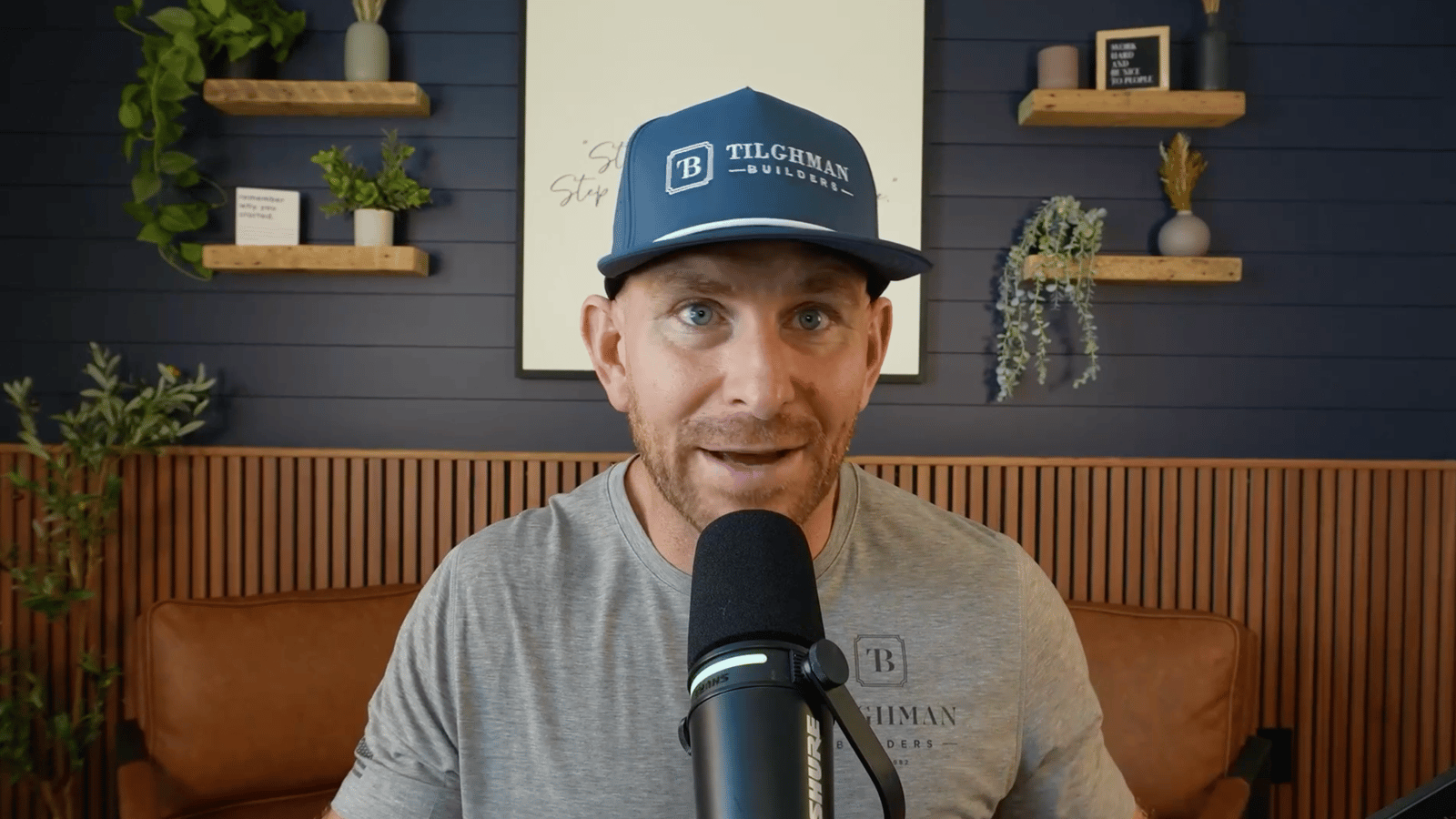
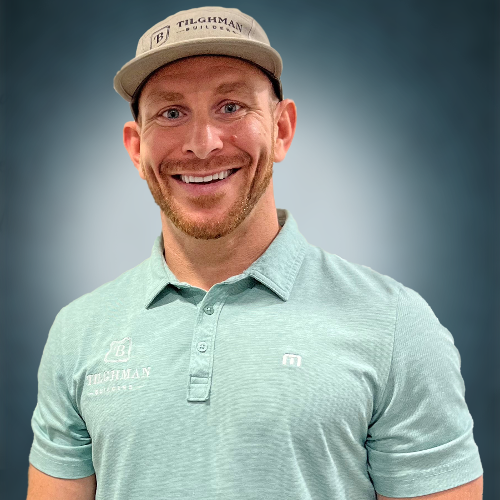
Eric Tilghman, CEO of Tilghman Builders, welcomes back an old face on this episode of the Built Different Podcast: Bernie McCarthy, a lead carpenter who left the company nearly a decade ago – and just rejoined the team.
Bernie opens up about why he left back then, what pulled him back now, and how the company has transformed in the years since. The conversation turns into a bigger reflection on almost 40 years in the trades: why culture matters more than any process, why "the bedrock is the people," and what it means to spend the final chapter of a career trying to leave something behind.
It's an honest, unscripted conversation about construction, loyalty, and building a business people actually want to come back to.
WATCH HERE:
Follow and listen to other episodes here:
 |
 |
 |
Bernie: I think the industry is great. I think today's youth should pursue more construction jobs. Trades will never die. You will always need plumbers. You're always going to need carpenters. You're always going to need electricians. They will never die. And you can make a good living in the trades.
Eric: Hi, everyone. Welcome back to another episode of the Built Different Podcast. I'm Eric Tilghman, the CEO of Tilghman Builders and your host. The man sitting to my left is actually a brand-new employee, a brand-new team member, but I know so much about him. He's got a wealth of knowledge in construction. He's spent his entire life in construction. I know him as a person. I know his character. And the reason I know that after he's only been with us for about two or three weeks is because he worked here once before. Everybody, I'd like to introduce Bernie McCarthy. Bernie, welcome to the podcast.
Bernie: Thank you, Eric.
Eric: You're welcome. We're a little bit late on this podcast, and that's because Bernie was away last week celebrating 25 years...
Bernie: That is correct.
Eric: ...of marriage. And I really wanted you as my next guest, so I held out. So how are you feeling, man?
Bernie: I feel good. I do. I feel better now that I'm three weeks in.
Eric: Good. Okay, cool. So let's start with this. You were with us, what was it, seven or eight years ago?
Bernie: Through COVID.
Eric: Through COVID. Okay. And you were a lead carpenter for us.
Bernie: That's correct.
Eric: Do you think that was the right role for you at the time?
Bernie: At that point in time, yes. And honestly, from being in that position then, I have an appreciation for the eight lead carpenters out there now.
Eric: Yeah, their job's not easy. And when you left, I was a lead carpenter at the time, I think, right?
Bernie: Yeah, you were a lead carpenter. And Jay.
Eric: And Jay, got it. And you were with us for what, a year?
Bernie: Almost a year.
Eric: Almost a year. And then when you left... I forgot all about this, but you mentioned it when we met recently, before hiring you back. You mentioned that you left frustrated, and it kind of unclogged my memory. I vaguely remember. But tell me about that. Why were you frustrated? What was going on?
Bernie: I had help, carpenters who were supposed to be carpenter threes helping me, that wouldn't get on a roof. That was frustrating. I had my son helping me, and he and I did the roof. And Bob said, "We're trying to get help, we're trying to get help." And help never came. So I chose to go elsewhere, which didn't pan out so well.
Eric: Yeah. I mean, the company was just a totally different structure back then, wasn't it?
Bernie: Absolutely. It's nothing like this now.
Eric: Other than the help, the lead carpenter role was a difficult one. There was a lot that fell on leads, you know, ordering and different things like that. How was your experience with all that?
Bernie: That wasn't that bad. Honestly, Bob teed it up. If anybody knows how Tilghman works, you're given a binder, and all the information in that binder is pertinent to the project. From there, it becomes your project. You own it. Lead carpenters, you're the face on the job every day.
Eric: Right.
Bernie: The saving grace is that on one of the jobs I was doing, the homeowner lived in California, so we would FaceTime after lunch to offset the time difference. But it was good, and I had good help. We remodeled a whole house. And then it stopped, and then COVID came.
Eric: Right. Did you leave right before COVID?
Bernie: No, we were here through COVID. We sat for six weeks.
Eric: Is that right?
Bernie: We would do Zoom calls every week.
Eric: You were with us during that time.
Bernie: And all the trim and finish details were sitting up there at that project.
Eric: So did you leave in 2020?
Bernie: I left in 2020.
Eric: What month did you leave? Do you remember?
Bernie: October.
Eric: October. So were you here when I transitioned out of the field and into the office?
Bernie: Yes. You had just stepped into that role.
Eric: Because I remember now the job you were on. It was called...
Bernie: The Vella project.
Eric: That's right. I remember exactly the project. It was a two-story addition off the back, opening up the back wall to the new kitchen, and then there was a fireplace and living room. There was a deck, or maybe just stairs down, I forget.
Bernie: That's correct. It was a deck.
Eric: Dude, that's wild. I forgot all about that. That was one of my first projects where I had to go and be customer-facing with not my customer.
Bernie: I commended you because you did a great job, especially when he had that one issue with the framing. You came out and backed us up.
Eric: Thanks, man. I didn't have much practice at that point. So let's talk about this. You've spent your whole life in construction, so you're a valuable person to talk to, especially on this podcast. And just a reminder for all of you: this podcast (some people think I'm crazy for doing this) isn't really geared toward clients. It's really geared toward other contractors, or really any other industry leaders. But today we'll probably focus more on construction than other industries. I think you've called yourself a dinosaur in the industry.
Bernie: I am a dinosaur.
Eric: So I'll use that term too. But having somebody who's been in the industry that long is valuable to me on this podcast, which is trying to encourage other contractors to run their business a different way, putting culture first and things like that. So what has life been like for you in this industry for, what, 25 years? 20 years?
Bernie: I'm 57 years old. I've been doing it since I was 18.
Eric: Dude. Almost 40 years.
Bernie: Almost 40 years.
Eric: All right. Wow, I got that way wrong.
Bernie: I'm only nine years younger than Bob.
Eric: You're not that old. You're a young dinosaur. I take it back. So what are your opinions of the industry?
Bernie: I think the industry's great. I think today's youth should pursue more construction jobs.
Eric: I agree.
Bernie: Trades will never die. You will always need plumbers. You're always going to need carpenters. You're always going to need electricians. They will never die. And you can make a good living in the trades and take pride in it. I always liked framing because at the end of the day, when you're packing up your tools, you look back and say, "I built that today." It's a good feeling.
Eric: It is a great feeling. You can't match it.
Bernie: You can't.
Eric: And now that you've been in the office for a while, and I have too, there's this kind of gloomy gray cloud that can hang over you that you don't really get when you're out in the sun framing a house. There's no room for stress when you're out there. It feels good.
Bernie: I would agree. This is a different facet of construction. You're seeing it before it actually transpires into the physical product in the field. Very neat to learn. And again, I'm here to facilitate the field as much as I can. We talked about it yesterday: smooth everything out. It's going to work. It's going to work well.
Eric: Well, I look forward to that. I really do. When we met recently and you decided to come back, why did you decide to come back? What was the reason?
Bernie: Really, I've always followed Tilghman Builders and your podcast on Facebook. And then the culture, and that is not a lie. We talked about this as well. People enjoy working here. People enjoy each other's company. This is not a 4:00, 4:30, they hop in their cars and disappear. The Friday before Labor Day, a bunch of us went out and had pizza and a couple of drinks. Tilghman Builders makes you want to do more. That's about the best way I can sum it up.
Eric: That's cool, man.
Bernie: You leave here happy, and you're excited to come back the next day.
Eric: That's nice to hear. And you've been coming into my office over the last couple of weeks saying sort of that, right? I can tell that you're excited, and I can tell that you see what we're doing. You can see the difference. It's hard to explain on this podcast or depict on social media, but the people who work here know it because they feel it. And I think that's what you're feeling. I hope that what you're witnessing and feeling is congruent with what you thought it would be.
Bernie: If not more. It is a true team here. We just talked about coaching kids' sports: Together Everyone Accomplishes More. That's what happens in this building.
Eric: That's cool.
Bernie: And it does transpire to the field. One of the fortunate things I got to do when I started, while you were on vacation, was that JP said, "Go out and meet the guys." So I met all the lead carpenters. I met the crews. Every one I walked up to knew I was arriving, and they shook my hand and introduced themselves. They are the best out there.
Eric: That's good to hear. Yeah, they're good guys. On my last podcast, I talked about how you can't have a bunch of guys who hate their job and then send them into Mrs. Smith's house and say, "Okay, action," and expect them to fake it and be somebody different. That would be exhausting. So my whole thing is, it starts with the hiring. I want to hire good people who are nice. They have a good moral compass. They have good values. They have some things they're passionate about in life. They're just nice people. But then after that, I want them to show up as exactly who they are, to show up as themselves, because there's nothing more exhausting than having to fake anything.
Bernie: I agree.
Eric: So the fact that they greeted you and were welcoming is good to hear. I would expect nothing less. So let's see. We talk about culture, and it's such a blanket statement. You're new to this conversation, right? But what do you think company culture is? What does that even mean?
Bernie: I think that from this office down to the field, they take pride in what they do. They like working for Tilghman Builders. They take pride in their work and in Tilghman Builders.
Eric: Why do you think that is?
Bernie: Because of the way they're treated, because of what is given to them, because of the training they get. We can put it out there now: the lead carpenters rotate help, so they get skilled in all facets of construction. If the carpenters don't appreciate that, then they're missing out.
Eric: Yeah, that's another big thing, the training. I always talk about how company culture is the way we talk to each other, treat each other, make decisions, blah, blah, blah. But it also just has to be real, right? Teaching young carpenters costs money.
Bernie: Yes, it does.
Eric: It does. But if we really care about those young carpenters, the conversation's over. Of course we're teaching. We have to teach. And we want to. And that's something I know JP loves about his job, watching the guys climb. He's really good at that, if you haven't seen it yet.
Bernie: He's excelled in seven years. Teaching them is an investment in Tilghman's future. And anybody who knows Jay, the senior estimator, knows he's been here since, what, high school?
Eric: Yeah, he has. High school. It was like summer, and then he went back to school, and then boom, workforce. So 17, 18 years old. What is something we're doing today that you wish we had been doing when you were a lead carpenter here?
Bernie: That's a very good question. Obviously, I'm in a position where I'm going to aid the crews as a project manager, make sure they have everything complete, make sure they have every piece they need. I'm going to tee them up to shine. All I want at the end is for them to say, "Thanks, Bernie." Again, if you don't understand how they work, they are the face of Tilghman every day on the job. The homeowners might get a little antsy with them, and I could stop by and drop their temperature a little bit. But the lead carpenters are phenomenal at what they do, and they're there to progress through the project. I'm just there to push them, to drive them.
Eric: You kind of brought that back up yesterday. I didn't really know this until then, but I think I asked why you want to do a good job, and you said basically exactly that. I don't know if you want to impress the field, but you want them to feel like you are truly helping them. You want to tee things up, and then when they turn for a piece of material, boom, it's there. And it's like, "Oh, thank you, Bernie." Right? Did I sum that up?
Bernie: Absolutely. I want them to know that they're not out there by themselves. I've got their back.
Eric: That's a really important and healthy leadership motivator. I don't know if it's all of it, but it's a big one, along with accountability. And I share that too. When I was in your position, I never wanted to be embarrassed in front of my field crew or a customer.
Bernie: I concur.
Eric: How embarrassing would it be to hear, "So you didn't measure the window? What do you mean you didn't measure the window?" I guess that's a pride thing. Shame on me.
Bernie: But it is. You take pride in what you do.
Eric: Yeah, I do. And I'm glad to hear you do too. I'm excited to see how you can affect the field crew in a good way. So let's see. This is a big one. We're going to tread lightly here because I actually want this to be my next solo episode. But I've noticed that when new people come into the company, there's a difference. There are young guys, and then there are older guys who have been around the block for a while.
Bernie: Okay.
Eric: The difference is this: young guys come in, they see the pretty building, they see the shiny thing, and they're like, "Oh, this looks great." It's kind of like how Google has ping-pong tables and beanbags. But you see it in a different light. It is different from other construction companies. What I see most often (I'll get to the point) is that a lot of times older guys will come into the company, say as a carpenter, and we preach the whole culture thing. We're energetic in our team meetings, and we compliment each other with our shout-outs and things like that, which you witnessed at the team meetings.
Bernie: Yes, I did.
Eric: We're all just really nice to each other. And what I see more often than not with the older guys is they come in and they're like, "Whoa, this is a little weird." They kind of reject the culture at first. They're kind of quiet in the team meetings, and they're kind of quiet about the shout-outs. They don't like to get a shout-out because then they have to give one, right? But over time, they come around. It's almost like their personality lightens up. They brighten up. They begin to glow, kind of, and they're happy to give a shout-out and happy to receive one. It's at that point that they've completely accepted the culture, and now they're all in. You seem to be all in out of the gate. Why is that? What's the difference?
Bernie: Honestly? Because I know you, I know JP, I know Bob, and I know Jay. And I know how Tilghman Builders worked back then. I've given you kudos for what has developed here and how refined it's gotten.
Eric: Thanks.
Bernie: This is way better than it was seven years ago. But I am fortunate that I know you.
Eric: That's a good answer. And for the viewers, we're far from perfect, far from done. There's always a problem. There are miles of improvement in front of us. But I appreciate you saying that. And really, I only did a little. I just share the vision. It's JP, it's Al, it's everybody on the whole team. And then the team's grown, and that vision has gone down through the ranks. But it's the team. That's what I'll say to that. I do a small portion at this point compared to everybody else.
Bernie: But you're a part of it, though, right?
Eric: Yeah, 100%.
Bernie: While you were gone, JP gave me the task of sitting with everybody in the office, seeing the job from the initial phone call to the final cabinet pull. I met the team. I sat with them and understood how the company progressed, how fast it progressed, and how it was refined from the initial sale to the handoff to project development.
Eric: It's funny, I never thought about this until now, and this is not like an SOP. We have a kind of onboarding process we go through, but we don't onboard your position very often, right? It's a big position. You're the third one, or the fourth if I include JP. But my onboarding for JP was like, "Just don't mess it up. Get in there." And it's so funny, because I was away on vacation. JP and I did not go over a game plan, strategy, what to do with you in your first week, or anything. But step one was "go meet the people." That's weird, you know? And I love it. It's different. There's a whole bunch to learn, but we need to start right here on the bedrock, and the bedrock is the people. So go ahead, go meet them, come back when you've finished meeting them, and then we'll tell you how to do your job.
Bernie: And that's what JP let me do.
Eric: That's hilarious. That's awesome.
Bernie: But again, I think it's going to be beneficial. I know how the process works. I know the field. Steve, you're the only one I didn't meet, if you watch this. And yeah, it is a family. I'm not kidding. It really is a family.
Eric: Well, I'm glad you're back, man. I'm glad you're a part of it.
Bernie: I'm glad to be here.
Eric: Do you think being at this stage of your career has changed what you value in the company you work for?
Bernie: Yes, that's a great question. You asked me when we met, before I came back, what I wanted. At this stage in my career, I want my knowledge to be used. I do know a lot about construction, and I want to feel valued. I want to make a difference. I want to contribute. My father passed away a couple of years ago. He always said life is about contribution, and that is very true. So if the young carpenters want to sit and talk with me over a piece of pizza at lunch, I'll have pizza with them at lunch. I'd like to teach, and I'd like to coach. We were just joking about kids and coaching. I miss that. My kids are grown up now.
Eric: Yeah, it is weird how life changes. I don't know when that is. For me, it was maybe when I became a dad, definitely not before. But eventually a man just wants to contribute, to affect the world in a positive way. It sounds corny, two grown men sitting here, but it's real. At least for anybody who works in our company, I would hope that would motivate them. When I die, I just want people to say nice things about me. I want them to say, "You know what? He helped me out with this. He said this one thing, and man, it was at the perfect time, and something clicked, and boy, that changed the trajectory of my life." Or maybe, "He taught me carpentry and got me excited." It's real.
Bernie: And I believe you, because I do that too. It is real.
Eric: All right, cool. Well, I don't hope, I know, that this can be a good place for you to capitalize on that. There are a lot of guys on the team. I just always wanted to create a place where people could work and grow and reach their potential. And like you, I love the trades. I know that's a whole debate right now, especially with AI. You've got college, and then you've got the trades, and it's a whole conversation, especially right now with AI. But I've always felt like you can make a great living in construction.
Bernie: Absolutely.
Eric: Personally, I think carpentry is the best one. I'm glad I'm not an electrician or a plumber. Carpentry's the best.
Bernie: Carpentry is the best.
Eric: That's right. Let's see. What are you most excited about with the new role, looking at where the company is headed? I know you don't know all of our problems (we have them), and I'd love for us as a team, with your help, to continue to fix those problems. But what are you excited about in where this company is headed? I know it's early, but what are you daydreaming about? What are you thinking about on your ride home?
Bernie: The future. Really, just to make it smoother. Smoother transitions, smoother projects. You've already refined the sales process and the process from sales to finish, which we spoke about last week. Now it's just the physical aspect, the actual project itself: to alleviate any problems prior to construction, see the scope of the work, go through it mentally, envision it, and then pass it on to the lead carpenter on the job. Comb out all the bugs. That's an area we could improve. That's what we spoke about yesterday.
Eric: Yeah, for sure. With some of the issues we face today, the issues bother me. I'll be honest, I'll be open on this podcast: profitability has been an issue recently. And although it bothers me, nobody's getting laid off, everybody's getting paid, all that kind of stuff. But we could do better. The reason it bothers me but doesn't scare me is because, again, we have that bedrock that is so unique. Our team cares about where they work. The company is like a living, breathing organism, right?
Bernie: Absolutely.
Eric: And we all care about it. So it's like, okay, profitability's off. No problem. Let's just talk to the team, because I know that they care. I know that they'll make adjustments, and we've seen that over the last four or five months, ever since we determined that. So you smoothing things out is exactly what we need. And I think you have a lot of smart people here to help you with that. So you've said that you want this to be your final chapter in a long book. I thought the book was shorter, but now I know it's almost 40 years of construction.
Bernie: Yes. This is the final chapter.
Eric: All right. And you also mentioned 10 years. I'm going to hold you to every one of those years. So what do you hope? We've got all these chapters leading up, and then boom. After the book is written and you look back at that last chapter, what do you hope to see?
Bernie: I hope to see that I took pride in what I did, that I did teach people, and that people will remember me. The silly statements I make, like "Proper preparation prevents poor performance." They're going to remember that. "The difference between a good job and a great job is 15 minutes. Take the 15 minutes." Sayings like that. I hope they appreciate what I did to help, even though I'm not physically out there swinging a hammer with them.
Eric: Man, I can't wait. I know the guys are going to like you. You've already met them, and I'm sure they already do. You're a good guy. It's funny to bring you on, because we got to skip the part where we have to get to know each other. We already did that.
Bernie: It's a bonus.
Eric: It really is. So I know they're going to like you, and I can't wait to see you cruising in your position. I know right now you've got your hands tied. JP's spoon-feeding you work little by little.
Bernie: JP, he's aces. He is incredible at what he does.
Eric: Yeah, he is. But I look forward to the day that you've got your stuff, he's got his stuff, and we can have more happy hours after work on Friday and celebrate a good week.
Bernie: Absolutely.
Eric: So it was good to have you on the podcast, man. I appreciate it. I know this is probably weird for you.
Bernie: It's a little weird. But it's easy because I'm talking to you. So I appreciate the invite, and I appreciate your diligence.
Eric: 100%. I'm glad you're back on the team, and I think the future's going to be bright with you here.
Bernie: As do I. I think it's going to benefit everybody.
Eric: Cool, man. Well, everybody, thanks as always for staying tuned. Stay positive, be nice, and step out of your comfort zone.