


What if the best way to create happier customers had nothing to do with the customer?
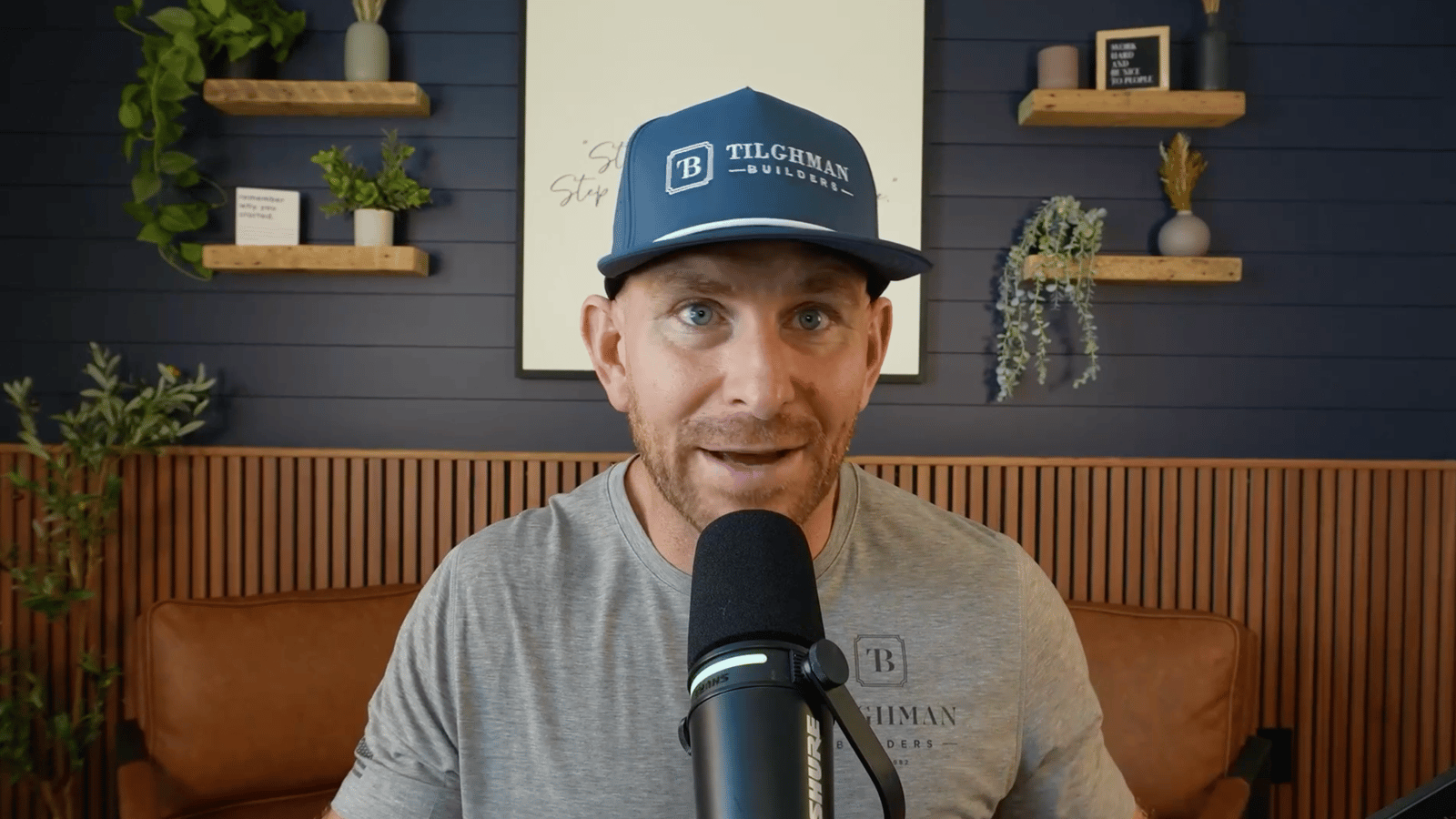
In this episode of Built Different, Eric Tilghman explains why the customer experience actually begins inside your company – with your people, your leadership, your standards, and your culture.
From the way employees communicate and handle mistakes to how they treat each other on the jobsite, customers experience your company culture whether they realize it or not. And in an industry like construction, where your team may spend months inside a client's home, those small interactions can make or break the entire experience.
Eric shares why accountability builds trust, why happy employees have more capacity to care, and why some of the most powerful customer-service moments happen when something goes wrong.
Because at the end of the day, great service isn't something you manufacture.
Build a healthy culture, and happy clients become the byproduct.
WATCH HERE:
Follow and listen to other episodes here:
 |
 |
 |
Happy Clients Start With a Healthy Culture
Hi, everyone. Welcome back to another episode of the Built Different podcast. I’m Eric Tilghman, your host and the CEO of Tilghman Builders.
Happy clients are a byproduct of a healthy company culture.
Today I want to talk about culture, but probably from an angle that you’re not used to hearing about it from. Because when we talk about company culture, we usually talk about employees, retention, morale, hiring, leadership, and whether people enjoy coming to work.
Obviously, all of that matters. But there is another person who is experiencing your company culture every day, and that is your customer.
They might never come to a team meeting. They might never hear you talk about your core values. They don’t know what you talk about at your leadership meeting on Monday morning, and they certainly don’t know your org chart.
But they experience the results of those things.
I’ve said it for years: our happy clients are absolutely a byproduct of our healthy company culture. And I really, really believe that.
You can spend all the money in the world trying to create an amazing customer experience. You can buy the best CRM tools, create scripts, send surveys, give gifts, and create SOPs. All of those things help. They’re all really important.
But ultimately, your people are the customer experience.
The customer experience starts inside the company.
I think a lot of businesses look at the customer experience from the outside in. They say, “How do we make a customer happy?” And I think that’s the wrong place to start.
I think you start inside the company.
How do we build a healthy organization? How do we hire good people? How do we treat those people? How do those people treat each other? What behaviors do we tolerate? What do we celebrate? What do we hold people accountable for?
Because all of those things eventually make their way to the customer. You build the culture, and the customer experiences the result.
And how your people treat each other matters.
Think about this: if kindness and respect are normal inside your company, those things don’t have to suddenly appear when an employee walks into a customer’s house.
The opposite is also true.
If your company is filled with gossip, blame, resentment, disrespect, people who don’t feel appreciated, or people who don’t trust the leadership, you can’t just expect them to walk into your customer’s home and flip a switch.
Culture travels. Eventually, the customer feels it.
That’s especially true in construction because we’re not selling something and then disappearing.
I sometimes tell new customers that I fantasize about my next life having a T-shirt shop on the boardwalk. People walk in, they want a T-shirt, and 10 minutes later they leave with a T-shirt and they’re happy. We just have to hold it together for 10 minutes. It’s a pretty short transaction.
But in this line of work, we might be inside somebody’s home for three months, six months, maybe even longer.
The homeowner gets to really watch our culture happen in real time.
Accountability Becomes Customer Trust
One of our core values is accountability, and accountability has a massive impact on the customer’s experience.
Construction is not perfect. We are definitely going to make mistakes.
Something might get damaged. Someone might install something incorrectly. A schedule might move. We might miss something. Unfortunately, that’s just the reality of construction.
So the question isn’t, “Will we ever have a problem?” Of course we will. There will probably be many problems.
The real question is: What happens next?
If your culture teaches people to hide mistakes, blame someone else, make excuses, or just hope somebody doesn’t notice, eventually the customer pays for that culture.
But what if your culture says: own it, communicate, fix it?
Now the customer has a completely different experience.
Something I’ve learned is that sometimes the way you handle a problem can actually build way more trust with a customer than if the problem had never happened in the first place.
Because they get to see who you really are.
I say it all the time with my team in the office: I love a good apology. If I make a mistake with a team member, I don’t get too upset about the mistake I’ve made. I actually look forward to when I get to apologize because, from there, the relationship just goes up.
Now they know something else is true about me: I know I’m not perfect, I will own a mistake, and I will say sorry.
Happy Employees Have More Capacity to Care
This is another one that I think business owners underestimate.
You can’t completely drain your people and then expect them to give your customers an incredible experience.
Think about a carpenter who’s exhausted from working 60 or 70 hours a week. He’s angry. He doesn’t feel appreciated. He doesn’t like his boss. He doesn’t trust the company. He’s burned out.
Now we expect him to walk through the door of Mrs. Smith’s house and smile, be patient and thoughtful, communicate well, and care deeply about her experience.
That’s a pretty big ask.
People only have so much energy. If the company takes all of it, there’s not much left for the customer.
That’s one reason I’ve never wanted to build a company around this idea that everybody needs to grind themselves into the ground.
I want people to have lives. I want them to see their families. I want them to have hobbies. I want them to have energy when they come to work.
Taking care of people isn’t just an employee benefit. It should be part of your customer service strategy.
Healthy Culture Creates Better Communication
Communication, especially in construction, might be one of the biggest differentiators.
Clients don’t necessarily expect everything to go perfectly, but they absolutely want to know what’s going on. They want to know what’s happening, what’s happening next, and what we’re doing about it if there’s a problem.
A healthy culture communicates.
People aren’t afraid to raise their hands. Bad news doesn’t get buried. Problems don’t get hidden. Questions aren’t viewed as annoyances. People tell the truth early.
There’s a really important principle here:
The speed at which truth travels through your company determines how quickly you can solve problems for your customers.
If my carpenter sees a problem but he’s afraid to tell the project manager, and the project manager is afraid to tell operations, and operations is afraid to tell me—and certainly nobody wants to tell the client—we’ve got a big problem.
That’s not just a communication problem. That’s a culture problem.
We Want the Shirt to Mean Something
This is probably the biggest thing about company culture.
There is a difference between someone who works for your company and someone who feels like they are a part of your company.
When somebody’s proud of the logo on their shirt, they protect it.
You see that in the tiny moments.
They walk past some trash on the floor and pick it up. They see another carpenter struggling and help him. They notice something isn’t quite right, so they say something. They see a homeowner who’s confused, so they stop and explain what’s happening.
Nobody told them to do it. Nobody’s checking a box. There’s certainly no SOP that says, “At 2:17, notice that Mrs. Smith looks confused and go ask her if she’s okay.”
They just care.
That’s the culture.
And it’s those tiny moments that customers most often remember.
The customer sees how your people treat each other. In construction, your customer sees how your team interacts. They see how your lead carpenter talks to your apprentice. They see how your project manager talks to the carpenter.
They see how your employees talk about the company when leadership is not around.
They see what happens when something goes wrong. They see whether the electrician and carpenter help each other or blame each other. They see whether your people actually enjoy working together.
Believe me, they can feel it.
The jobsite is basically a live demonstration of your company culture, which should be a mirror image of you as the leader.
Maybe We’re Looking at Customer Experience Backwards
Businesses spend an enormous amount of time and money trying to improve the customer experience—with training, scripts, surveys, gifts, technology, especially with AI right now, and follow-up emails.
Again, those things are really, really important.
But what if the biggest customer experience initiative you could take had nothing to do with the customer at all?
What if it was simply:
Hire better people. Treat them well. Hold them accountable. Give them purpose. Communicate honestly—which starts with you. Create standards they’re proud of. Protect your culture.
And when someone consistently poisons that culture, have the courage to do something about it.
Then let the customer experience become the byproduct.
What Our Clients Are Really Reviewing Is Our Culture
When I read a review from a customer, it’s pretty much never about me.
They’re reviewing our culture.
They’re reviewing the carpenter who cared. The project manager who called them back. The person who made a mistake and admitted to it. The teammate who cleaned something even though it technically wasn’t their responsibility. Maybe somebody spent an extra five minutes explaining something.
That’s culture.
That’s culture showing up right there.
That’s what most of our reviews are about. It’s all about the people, 100%, and the way our people made them feel.
That’s what it’s always about.
It’s never about the carpentry. It’s never about the detailed proposal. It’s not about that.
And as your company grows, I think this becomes even more important because eventually your clients don’t experience your company through you anymore.
They experience your company through the culture that you built.
That’s a big deal.
I can’t be on every jobsite. I can’t personally talk to every client. I can’t inspect every interaction.
And I shouldn’t have to.
The culture should carry that responsibility.
So if you’re listening to this and you want happier customers, maybe don’t start with the customers.
Start with the people.
Build a company where good people want to work. Build a company where people actually care about each other.
Accountability has to be normal. Telling the truth has to be normal. People need to have energy left to care. And they need to be proud of where they work.
They have to be proud of the name on their shirt.
Because when you get those things right, you don’t have to manufacture great service.
It just starts happening naturally.
Healthy culture creates healthy teams. Healthy teams take care of people. And happy clients ultimately become the byproduct of that.
Our happy clients are a byproduct of our healthy company culture. I have said that for years. It felt right, it always did, and it has been true for years for us.
It wasn’t until we got the culture right that we got the customers right.
So, customers, I love you. I love you. But as you know from your initial phone call with me, I start with company culture all day.
Anyway, that’s it for today, folks.
As always, thank you for staying tuned. And as always, stay positive, be nice, and step out of your comfort zone.